Swiss startup survival, part 12 of 12
What I would tell a founder, an investor and a canton
The final part: what the evidence means in practice for founders, SME owners, investors and cantons, plus an agile playbook that turns one big bet into many small, reversible ones.
Twelve posts ago I asked why half of new Swiss companies close within five years. The answer fits in one sentence: new Swiss companies mostly fail because of how they start and which market they enter, not because of where they are or how much money they raise. This last part is about what to do with that answer.
50.7% on average
For founders
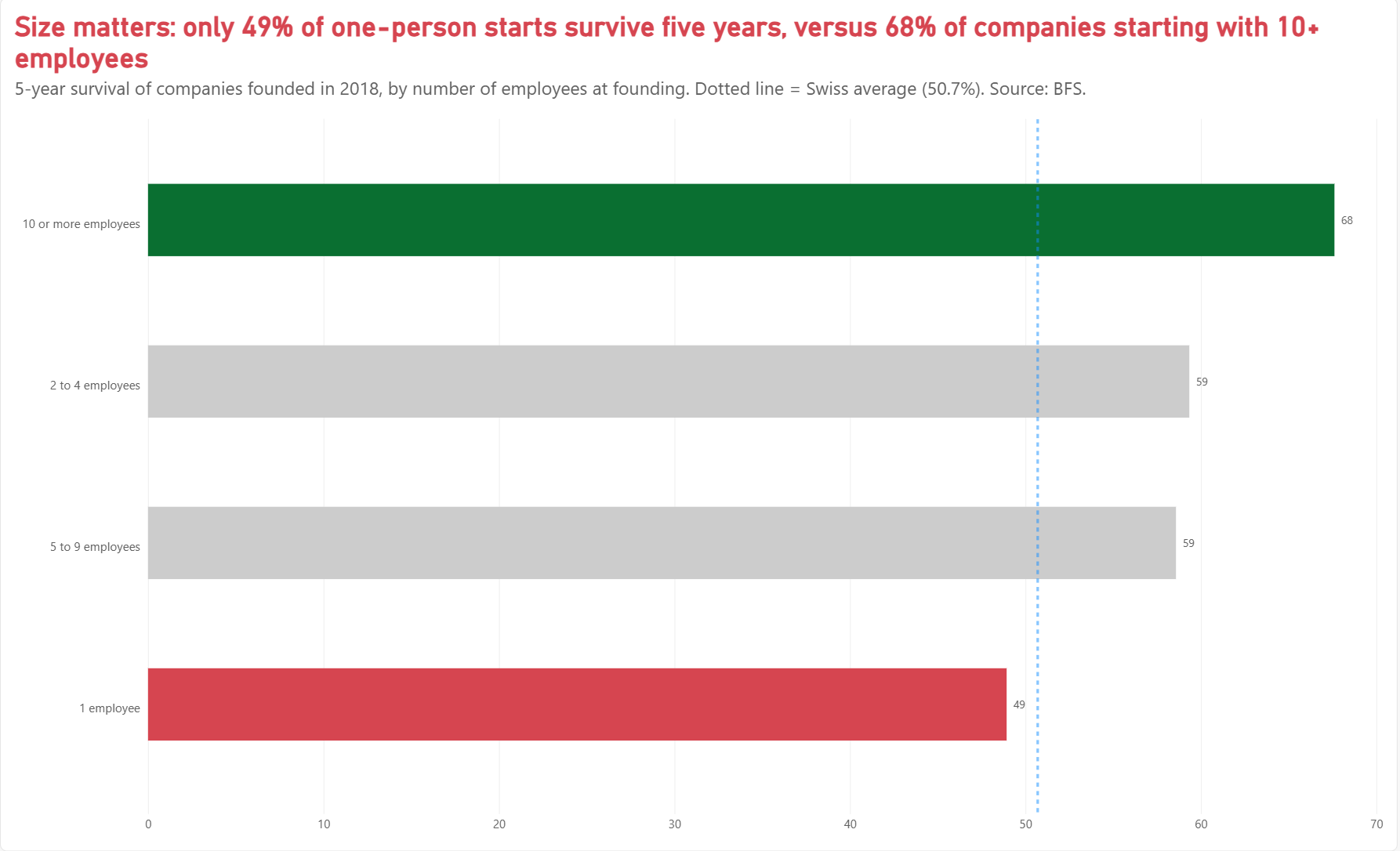
The most important decisions come before the first customer. Do not try to run the company alone: one-person starts survive 49% of the time and small teams 59%,1 so a partner, a first hire or a freelancer with complementary skills is worth more than almost anything else (part 5). Choose a market with a barrier, whether a licence, a hard-to-earn skill, a trusted relationship or a regulation, because barriers protected health while easy entry hurt hospitality and ICT (part 4). And test demand before the irreversible bet: no long lease or large contract until the concept has proven itself (part 10).
For SME owners
Put AI on the back office first, and write data rules before anyone pastes customer data into a tool (part 7). Track cash runway and unit costs every month, because most closures are slow, visible declines rather than sudden collapses. And share fixed costs with peers wherever you can, through staff pools, joint purchasing, or shared kitchens and workshops.
For investors
Look past AI labels and ask what part of the value survives when AI tools become cheaper. Capital has moved so strongly towards AI that many non-AI startups now raise money at lower valuations, which can be an opportunity for patient investors (part 6).
For cantons
Measure economic health by survival and jobs, not registrations, because a record founding year can hide a record closure year (part 2). Support companies in their second and third years, when most of them fail, and not only at founding. And publish survival by canton and sector together, so founders can see the real odds where they are.
An agile playbook for small firms
My Scrum training shapes how I think about this. Agile methods were built for software, but their core idea fits any small business: make change in small steps you can reverse, and inspect the results often. Before a big commitment, run a pre-mortem: imagine the decision failed a year from now, list why, and fix the top three reasons first. Start with the smallest possible test, such as a pop-up instead of a lease or a pilot instead of a rollout. Review every two to four weeks and decide whether to continue, change or stop, with the stopping criteria agreed before you start. And check that strategy, structure, systems, skills and people all support the change, not just the technology, as McKinsey’s 7S framework suggests.
Agile turns one big, irreversible bet into many small, reversible experiments. That is exactly what a 70% success rate requires (part 8).
What comes next
I will rerun this analysis when BFS publishes the next founding years, and two questions stay open for me: how much of Zug’s churn comes from foreign-owned companies, and what Swiss SMEs actually try, keep and drop when they adopt AI. If you work on either, I would like to hear from you. The full study is here, and the interactive charts are on the data page.
-
Federal Statistical Office (BFS), Company demography: survival rates. ↩