Individual research project Completed
Why do half of new Swiss companies close within five years?
My individual research and data analysis project, in full. I collected official Swiss statistics, analysed them in Power BI, and researched every explanation against at least two sources to find out which new companies survive, and why.
Why do half of new Swiss companies close within five years, and what makes the other half survive?
This page is the complete study, the same content as the 45-page PDF, rebuilt for reading on screen. It is organised the way a consulting report is: the answer first, then the evidence, then what to do about it. Use On this page to jump to any section, and follow the links to the blog posts that explain each finding in more depth.
Every number comes from an official or published source, listed at the end. Anything I call a possible explanation, a rating or a likelihood is my own judgement and is marked as such.
Executive summary · 2 min read
The answer in two minutes
New Swiss companies mostly fail because of how they start and which market they enter, not because of where they are or how much money they raise.
The answer in five points
- How a company starts matters most. Solo starts survive 49%, teams of 10 or more 68%. A GmbH or AG, which needs share capital, survives better than a sole proprietorship. Section 5
- Which market it enters comes next. Easy-entry, crowded sectors (hospitality, retail, IT services, consulting) survive worst; health, protected by qualifications, survives best. Section 3
- Location matters less, and mostly through the type of company a place attracts. Zug founds 2.5 times more companies per resident than Zurich, and keeps the fewest. Section 2
- Money does not explain survival. Venture capital reaches about 350 of more than 46,000 new companies a year. Lucerne gets almost none and survives as well as Zurich. Section 4
- AI is not yet the main cause of failure, but it crowds knowledge work, pulls capital to a few AI firms, and makes the AI decision itself a risk for small companies. Section 7
RememberThe survivors start with a team, enter a market with a real barrier or stable demand, and keep their early bets small and reversible.
Note · what cannot be proven yetAI's direct effect on five-year survival. The data that would show it, the 2023 founding cohort at year five, will only be published around 2030. Everything about AI in this report is strong circumstantial evidence, not proof.
Part 1: The data, what happens and where
Part 1 · Method · 4 min read
01 The question and how I answered it
One sharp question, five testable parts, and only official data to test them.
- Main question: why do half of new Swiss companies close within five years, and what makes the other half survive?
- Split into five parts: regions, sectors, money, size, AI.
- Data: BFS company demography, BFS population, Swiss Venture Capital Report 2026.
Only 50.7% of the companies founded in Switzerland in 2018 still existed five years later. For every two new companies, one was gone by 2023. A founding boom means little if half of it disappears.
The issue tree
Consultants break a big question into parts that do not overlap and together cover the whole (a "MECE" issue tree). Each part got a hypothesis before I looked at the data:
| # | Sub-question | Starting hypothesis | Result |
|---|---|---|---|
| 1 | Regions: which cantons do well, and why? | High-founding cantons survive less | Supported §2 |
| 2 | Sectors: which industries survive? | Hype sectors survive worse than average | Supported §3 |
| 3 | Money: does funding decide survival? | Low-funding regions survive less | Rejected §4 |
| 4 | Size: does how you start matter? | Teams survive longer than solo founders | Supported §5 |
| 5 | AI: who gains, who loses? | AI creates winners and losers | Partly, not yet provable §7 |
RememberA rejected hypothesis is a result, not a failure. Hypothesis 3 was wrong, and that turned out to be one of the most useful findings.
The data, and why each source
| Data | Source | Why this source |
|---|---|---|
| Survival of new companies by canton, sector, size, legal form | BFS company demography | Counts only genuinely new companies, excludes mergers, relaunches and holdings, and follows each founding year for five years |
| New companies, closures, active companies per canton and industry, 2013–2023 | BFS STAT-TAB | Gives counts, not only rates |
| Population per canton, end of 2023 | BFS STATPOP, cantonal statistics offices | Turns counts into comparable rates per 1,000 residents |
| Venture capital by sector, canton and round, 2025 | Swiss Venture Capital Report 2026 | The only complete record of Swiss startup funding |
Side noteThe raw BFS files came in German and Italian, with merged headers and footnotes. I translated them, put one value per row, mapped standard canton codes and left unavailable values blank instead of zero, so they could not distort averages.
Three design choices
- Why the 2018 cohort: it is the most recent founding year with a full five years of follow-up (2018 to 2023). BFS data runs about two years behind.
- Why five cantons: each plays a different role. Zurich is the hub, Basel-Stadt the life-science cluster, Zug the formation machine, Lucerne the rising challenger, Bern the control case.
- Why rates per 1,000 residents: Zurich has twelve times Zug's population, so raw counts would only measure size.
Key fact · quality checksThe cleaned canton data adds up to 46,883 new companies in 2023, against 46,931 published by BFS; the gap is cells BFS hides for confidentiality. The venture capital tables by canton and by sector both add up to exactly CHF 2,948m.
Part 1 · Finding 1 · 4 min read
02 Regions: Zug founds the most and keeps the fewest
More foundings do not mean a healthier ecosystem.
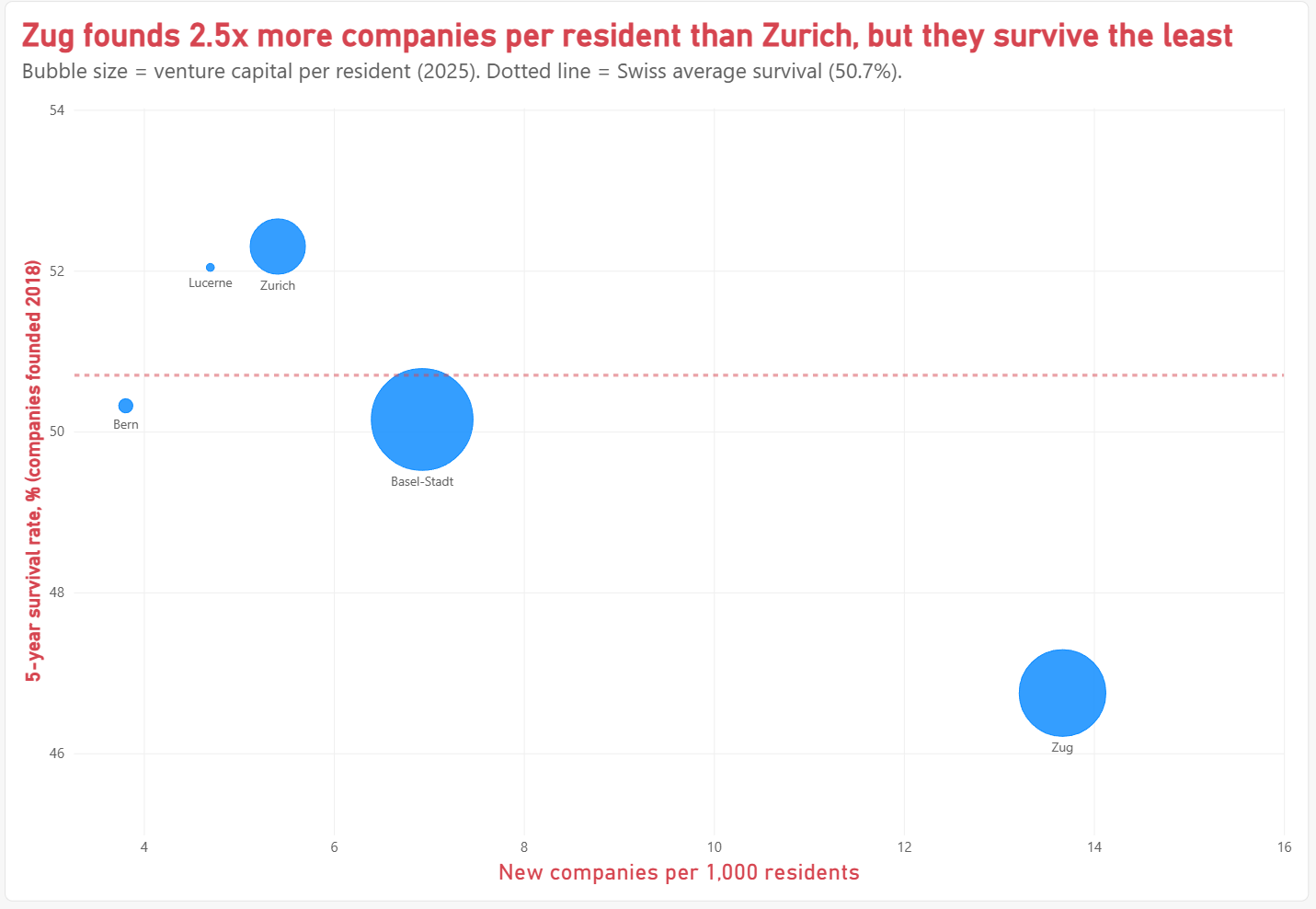
- Zug creates 13.7 new companies per 1,000 residents, about 2.5 times Zurich.
- Yet only 46.8% survive five years, the lowest of the five cantons, in 2013 and 2018 alike.
- Zug is a revolving door: highest founding rate and highest closure rate.
Try it yourself:
Try it yourself:
| Canton | Survival, 2013 cohort | Survival, 2018 cohort | Solo starts, 2018 | New per 100 active, 2021 | Closures per 100 active, 2021 |
|---|---|---|---|---|---|
| Zurich | 51.3% | 52.3% | 82% | 7.3 | 6.4 |
| Lucerne | 48.7% | 52.0% | 81% | 6.9 | 5.8 |
| Bern | 49.2% | 50.3% | 86% | 6.3 | 6.0 |
| Basel-Stadt | 46.5% | 50.1% | 83% | 7.7 | 6.1 |
| Zug | 46.7% | 46.8% | 77% | 10.3 | 7.5 |
| Switzerland | 49.2% | 50.7% | 83% |
Source: BFS company demography; own calculations.
What the data shows
- Zug's weakness is structural. It was also last for the 2013 cohort, so this is not one bad year.
- Size does not explain it. Zug has the fewest solo starts (77%), and solo starts survive worst nationally. On size alone, Zug should do better. Section 5
- Lucerne is the quiet improver: survival up from 48.7% to 52.0%, the biggest gain, and the lowest closure rate.
Possible explanations for Zug (my hypotheses)
- Foreign-owned companies: nationally they survive only 35% (Section 5), and Zug attracts many of them.
- Mobile, tax-driven firms that can leave as easily as they arrive.
- Crypto exposure: the 2018 cohort lived through crypto crashes in 2018 and 2022. But crypto explains only part of it. Section 12.5
Note · shell companies ruled outBFS company demography excludes holding companies and counts only firms with real market activity. Zug's low survival therefore comes from real operating companies, not mailbox shells.
RememberZug maximises volume, not durability. A canton that measures success by registrations will celebrate exactly the wrong number.
Go deeper in the blog post: Zug founds the most companies and keeps the fewest
Part 1 · Finding 2 · 4 min read
03 Sectors: the hype sectors survive below average
What a company does matters five times more than where it is.
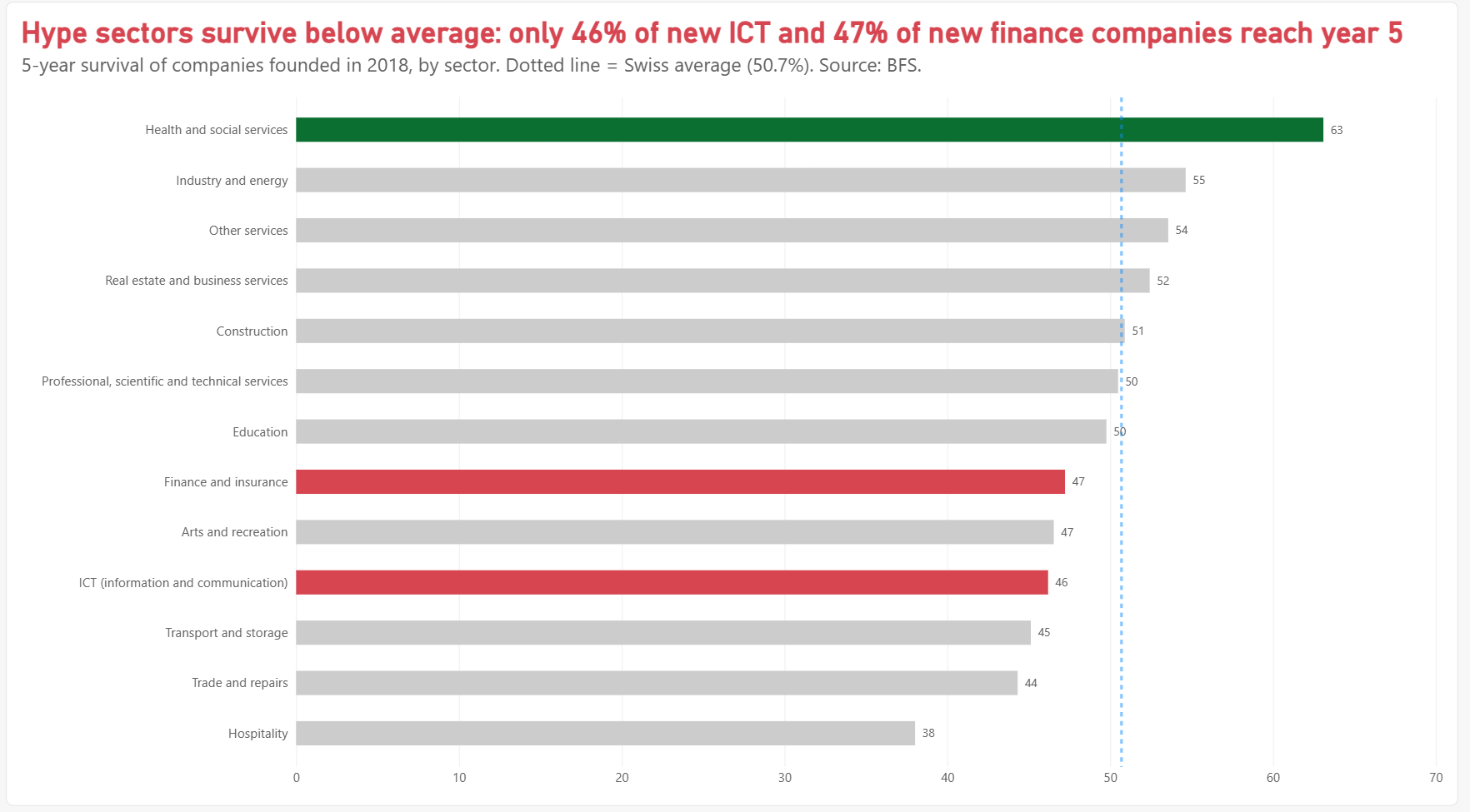
- Only 46% of new ICT and 47% of new finance companies reach year five, against 50.7% overall.
- Health survives best (63%), hospitality worst (38%).
- The sector gap (25 points) is about five times the canton gap (about 5 points).
Try it yourself:
Key fact25 pointsbetween the best sector (health, 63%) and the worst (hospitality, 38%). Choosing health over hospitality changes the odds far more than choosing Zurich over Zug.
What the data shows
- ICT and finance are below average, but not the worst. Trade, transport and hospitality do worse.
- Construction, real estate and business services sit near the average: ordinary local businesses with steady demand.
Possible explanations
- Low entry barriers: anyone with a laptop can open an IT or financial consulting firm.
- Regulation as protection: health needs licences, which keep weak entrants out.
- Stable demand: healthcare is needed in every cycle; software and fintech depend on funding cycles.
- Thin margins in hospitality, plus COVID closures inside the five-year window.
RememberHype does not bring durability. The honest message is not "tech is the worst place to start" but "the sectors that get the most attention do not produce the most durable companies".
Go deeper in the blog post: Health survives at 63%, hospitality at 38%
Part 1 · Finding 3 · 4 min read
04 Money: venture capital does not explain survival
The hypothesis I got wrong, and why that matters.
- Zug receives more VC per resident than Zurich and still survives worst.
- Lucerne receives almost none and survives as well as Zurich.
- VC reaches about 350 rounds a year against more than 46,000 new companies.
| Canton | VC 2025 (CHF m) | Rounds 2025 | VC per resident (CHF) | 5-year survival |
|---|---|---|---|---|
| Basel-Stadt | 572.3 | 18 | 2,861 | 50.1% |
| Zug | 268.6 | 30 | 2,026 | 46.8% |
| Zurich | 1,192.5 | 151 | 745 | 52.3% |
| Bern | ≥ 17.8 | 14 | ≥ 17 | 50.3% |
| Lucerne | 0.1 | 1 | 0.3 | 52.0% |
Source: Swiss Venture Capital Report 2026; survival BFS. Bern and Lucerne are not shown separately in the report: I rebuilt them from the list of individual rounds, so they are minimums.
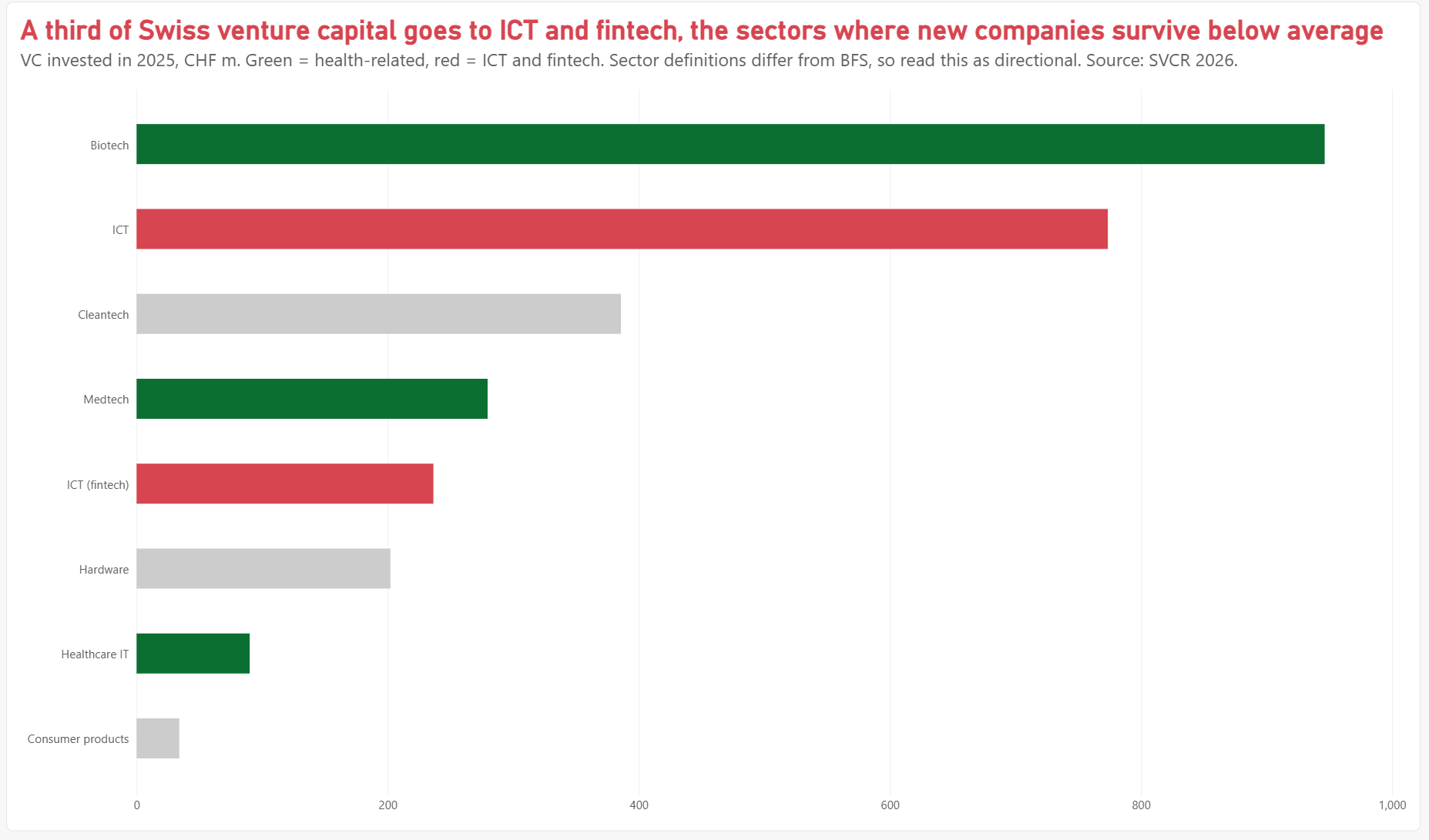
Try it yourself:
Side noteBFS "health" includes clinics and care homes; VC "biotech" means drug development. The sector comparison between the two sources is directional only.
Why money does not explain survival
- VC reaches very few companies. Most new companies are bakeries, consultancies and tradespeople that never seek venture capital.
- VC is a bet on fast growth, not on survival. Investors accept that most of their startups fail, as long as a few become very large.
- Lucerne shows another model: self-funding, bank loans and steady local customers (a hypothesis to research).
- At sector level, investors partly back the best survivors: health-related startups got about 45% of 2025 VC; ICT and fintech about 34%.
RememberVenture capital cannot explain the survival of companies it never touches.
Go deeper in the blog post: Money does not explain who survives
Part 1 · Finding 4 · 4 min read
05 Size: how a company starts matters most
The clearest pattern in the whole dataset: do not start alone.
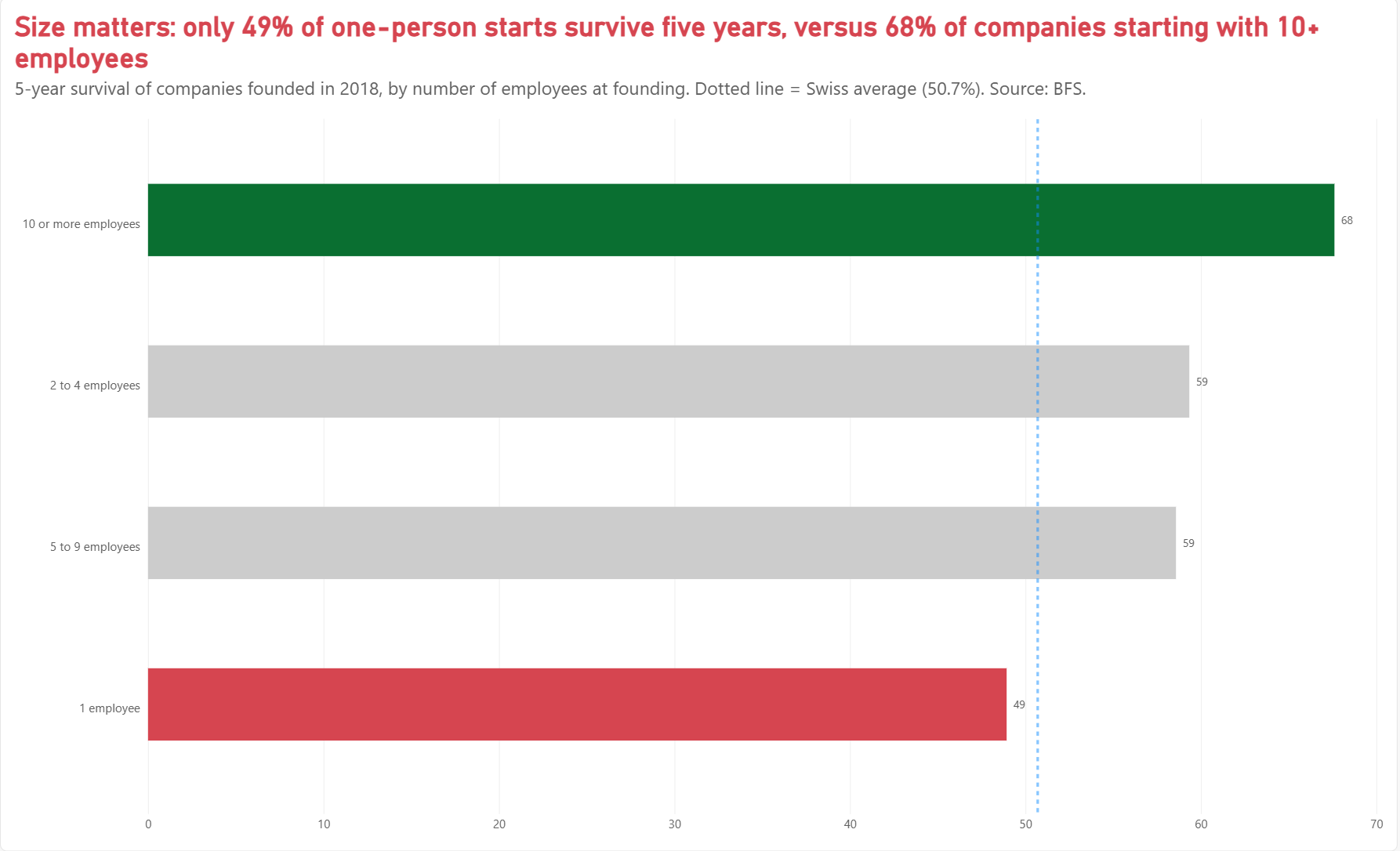
- 49% of one-person starts survive five years; 68% of companies starting with 10+ employees.
- GmbH (56%) and AG (55%) beat sole proprietorships (48%). Foreign companies: 35%.
- About 83% of new Swiss companies start with one employee: the weakest start is the most common.
Try it yourself:
Try it yourself:
| Legal form at founding | 5-year survival |
|---|---|
| GmbH (limited liability) | 56.1% |
| AG (public limited) | 54.8% |
| Cooperative | 52.0% |
| Sole proprietorship | 48.4% |
| Association or foundation | 43.1% |
| Partnership | 41.2% |
| Foreign company | 35.1% |
Source: BFS, 2018 cohort.
What the data shows
- The big jump is from one person to a small team: +10 points from 1 to 2–4 employees; 2–4 to 5–9 adds nothing.
- Capital at the start helps: a GmbH needs CHF 20,000 and an AG CHF 100,000 of share capital.
- Foreign companies survive worst, which links back to Zug. Section 2
Possible explanations
- Capacity: one person must sell, deliver, do the accounts and absorb every setback.
- Complementary skills: a team combines, for example, product and sales.
- Commitment: hiring or putting in share capital signals a more serious, better-prepared project.
Note · correlation, not causeBetter-prepared founders may both hire more and survive more. Adding staff does not by itself make a company survive.
RememberThe message is "do not start alone", not "the bigger the better".
Go deeper in the blog post: Do not start alone: why solo founders close more often
Part 1 · Synthesis · 2 min read
06 How the factors connect
How a company starts matters more than where it is or what it raises.
2018 cohort
Driver tree: own analysis of BFS and SVCR data. Ranking by the size of the survival gap each factor creates.
The factors also interact. Zug's low survival is not explained by size, since it has the fewest solo starts. It more likely comes from the kind of company Zug attracts: mobile, often foreign-owned firms in volatile fields such as crypto.
RememberLocation matters mostly through the type of company it attracts. Money matters least of the four.
Part 2: The AI question
Part 2 · Finding 5 · 7 min read
07 AI: who gains, who loses
AI is not the main reason companies fail today. It is reshaping who enters, who gets funded, and who gets replaced.
- AI startups went from 5% to 32% of Swiss VC volume in two years.
- After ChatGPT, foundings fell in AI-replaceable services and rose in advisory and marketing, the sectors with the highest closure rates.
- Most AI projects show no measurable return; for small firms, the AI decision itself is a survival risk.
Note · what cannot be proven yetAI's direct effect on five-year survival. The data that would show it, the 2023 cohort at year five, will be published around 2030. This section is strong circumstantial evidence, not proof.
7.1 Where AI is boosting
| Measure | Figure | Source |
|---|---|---|
| Share of Swiss VC volume going to AI startups | 5% → 32% in two years; about CHF 1.1bn in 2025 (+206%) | EY Startup Barometer 2026 |
| Swiss funding rounds involving AI startups | 163 of 515 (32%) | EY Startup Barometer 2026 |
| AI/ML among new Swiss deep-tech startups | One in four since 2022 | Swiss Deep Tech Report 2026 |
| Swiss SMEs consciously using AI | 22% (2024) → 34% (2025) | AXA/Sotomo via kmu.admin.ch |
| AI share of global venture capital | About 50% in 2025; 80% in Q1 2026 | Crunchbase via GCN |
7.2 Where AI hurts: what Swiss founding data shows
I compared new company foundings in 2023, the first full year after ChatGPT, with 2022, using detailed BFS industry data.
| Industry | AI exposure | New companies 2022→2023 | Closures per 100 active, 2021 |
|---|---|---|---|
| Advertising and market research | High | +15.8% | 9.0 |
| Management consulting | High | +3.7% | 9.5 |
| Information services | High | +3.5% | 10.0 |
| Design, translation, photography | High | −2.6% | 8.4 |
| Legal, tax and accounting | High | −6.0% | 5.3 |
| IT services | High | −7.1% | 7.9 |
| Publishing | High | −14.6% | 6.1 |
| Office and business support | High | −15.6% | 8.6 |
| Health | Low | +16.7% | 5.1 |
| Specialised construction trades | Low | +5.8% | 6.0 |
| Personal services | Low | +1.5% | 6.6 |
| Restaurants and bars | Low | −9.3% | 5.6 |
Try it yourself:
Source: BFS company demography; own calculations. The exposure grouping is my judgement, based on the ILO 2025 index, which finds clerical work most exposed, followed by digital professional work in media, software and finance.
Key factFoundings in high-exposure industries fell 1.3%; in low-exposure industries they rose 7.1%. The national total was flat (−0.1%).
Doing businesses shrank
Office support, publishing, IT services, legal and accounting: work whose output AI can now produce.
Advising and selling businesses grew
Advertising and consulting: AI makes it cheap for one person to open such a shop.
RememberAI pulls founders into the most fragile sectors: advertising and consulting already had 9 to 10 closures per 100 firms a year, against 5.1 in health.
7.3 Is AI actually useful in each sector?
| Sector | What AI does there | Effect on companies |
|---|---|---|
| ICT | Core product | Helps; the only sector where AI is often the business model |
| Finance, pharma | Analysis, compliance, research | Helps, mostly large firms |
| Consulting, marketing | Cheap content and analysis | Lowers entry barriers, which brings crowding |
| Translation, publishing, office support | Does the core work itself | Hurts |
| Health | Admin support | Neutral; growth comes from demand |
| Construction, trade, hospitality | Little | Irrelevant; these fail for other reasons |
RememberAI is valid where the work is text, code and data. The sectors with the most bankruptcies are physical and local, where AI barely matters.
7.4 Why AI fails where it fails
| Barrier | Best available number | Source |
|---|---|---|
| No measurable return | 95% of organisations saw no measurable P&L return within six months | MIT NANDA, 2025 |
| Projects abandoned | 42% dropped most AI initiatives (17% a year earlier); 46% of proofs of concept scrapped | S&P Global, 2025 |
| Money in the wrong place | About half of budgets go to sales and marketing; returns show up in back-office automation | MIT NANDA |
| Shallow use | About 60% of Swiss firms use AI; only 2% of micro-firms use it systematically | UBS via Netzwoche |
| No data rules | Only 34% of SMEs have rules for data entered into AI tools; 23% under 10 employees | AXA/Sotomo 2025 |
| Data protection | Local processing and data protection rated 8.7 / 10 in importance | EY Switzerland |
| Trust | 46% willing to trust AI; 66% rely on output without checking; 56% made mistakes because of AI | KPMG & Univ. of Melbourne |
RememberInvestors are not against AI. The problem is the opposite: AI absorbs so much capital that non-AI startups get less.
7.5 The snowball: how one company winning hurts another
Side note · solo foundersIn the US, about 36% of startups founded on Carta in 2025 had a solo founder, up from 31% in 2024. Switzerland shows no shift yet: about 83% of new firms start with one employee, as in 2013. If AI does push Swiss founders to start alone, Section 5 suggests survival would fall.
- Capital is pulled to the top. A few frontier labs absorb a large share of global funding; non-AI startups get less money at lower valuations. Swiss fintech fell from 41 rounds in 2024 to 30 in 2025 (SVCR).
- Big models squeeze the specialists. DeepL cut about 250 jobs, a quarter of its staff, and is still loss-making. If a translation AI champion is squeezed, human agencies are squeezed harder.
- Cheap tools pull founders into crowded markets that already have the highest closure rates.
- Established firms burn money on badly chosen AI projects, especially small firms with no data foundations.
- Meanwhile, the largest failure wave is not about AI. Construction, trade and hospitality lead the bankruptcies. Section 12
Go deeper in the blog post: AI in Swiss SMEs: who gains, who loses, and what gets dropped
Part 2 · Due diligence · 6 min read
08 The hidden denominator: why AI success rates mislead
"75% of companies succeed with AI" usually means 75% of the companies that got far enough to be asked.
- Five well-known studies give AI success rates from 5% to 74%.
- The difference comes from who was asked, what counted as success, and over what time.
- For a small firm making one large bet, even a 25–30% failure rate is a survival risk.
8.1 How the studies were built
| Study | Who was asked | Success means | Window | Result |
|---|---|---|---|---|
| Google Cloud | 3,466 leaders at firms above USD 10m revenue, already using AI | Any ROI | First year | 74% achieving ROI |
| IBM | 2,000 CEOs in 33 countries | The ROI they expected | Last few years | 25% delivered; 16% scaled |
| McKinsey | 1,993 participants in 105 countries | Any profit (EBIT) effect | Current | 88% use; 39% any effect; 6% large |
| S&P Global | Companies surveyed in 2025 | Projects kept vs dropped | One year | 42% abandoned most initiatives |
| MIT NANDA | 300+ initiatives, 52 interviews, 153 leaders | Measurable P&L effect | Six months | 95% no measurable return |
Sources: CodeIT comparison of Google Cloud and MIT; IBM newsroom; McKinsey State of AI 2025 summary; S&P Global and MIT NANDA as in Section 7.
8.2 Five reasons the numbers disagree
- Who is in the sample. Google asked only firms that had already deployed AI; projects that died earlier were never counted. This is survivorship bias.
- What counts as success. "Any ROI" is far easier to reach than "the ROI we expected" or "a measurable effect on profit".
- The time window. A project can fail at six months and succeed at eighteen, or the reverse.
- Who answers. Executives rate projects they sponsored themselves: self-assessments, not measurements.
- Who publishes. Google and IBM sell AI products; McKinsey sells AI transformation work. That does not make the data wrong, but a careful reader notes it.
8.3 The hidden denominator
Inside one single study, McKinsey, 88 of every 100 organisations use AI, 39 see any effect on profit, and only 6 see a large effect of more than 5% of EBIT.
"88% use AI" and "6% get significant value" are both true at once. Which one makes the headline depends on the writer.
Key fact · illustrationIf about half of AI projects die before production (S&P: 46% of proofs of concept scrapped), a 74% success rate among deployed projects is closer to 40% of all projects started. This combines two samples: read it as a demonstration of the denominator problem, not a statistic.
8.4 Why even a 25–30% failure rate is a serious risk
- Failure tells you where the AI does not fit. Klarna let an AI assistant handle two-thirds of customer conversations, the work of about 700 agents. In May 2025 its CEO admitted the result was lower quality and began hiring humans again. The AI worked for routine questions and failed on complex ones: the failures defined the boundary.
- Failures are under-reported. Successes get press releases; failed projects are quietly dropped.
- Gains are small, losses structural. Most firms reporting a profit effect say it is under 5% of EBIT; a failed rollout can mean layoffs, lost know-how, lost customers and costly rehiring.
- Portfolio vs single bet. A large company can run 40 pilots and accept that a third fail. A small Swiss firm usually gets one bet.
RememberA 70% success rate is fine for many small, reversible experiments and dangerous for one large, irreversible bet. For small firms, the AI decision itself is a survival risk.
Note · the research gapA credible study would need every project started (including dropped ones), one definition of success, a fixed time window, an independent publisher, and results by sector and company size. None of the five has all six, and no Swiss sector-level figure exists. A short survey of Swiss SMEs could close this gap.
Go deeper in the blog post: The hidden denominator: why AI success rates mislead
Part 3: The consulting view, from findings to strategy
Part 3 · Toolkit · 2 min read
09 The toolkit: frameworks used
Standard consulting tools, each chosen to answer one specific question.
| Framework | Origin | What it answers here | Where |
|---|---|---|---|
| Hypothesis-driven issue tree | Standard at McKinsey, BCG, Bain | Splits the main question into testable parts | §1 |
| PESTEL | Classic strategy tool | Which outside forces hit Swiss companies in 2026 | §10 |
| Porter Five Forces | Michael Porter, Harvard | How much competitive pressure each sector faces | §11 |
| McKinsey 7S | McKinsey | Whether a firm is internally ready for change, such as an AI rollout | §16 |
| Kotter 8 steps | John Kotter, Harvard | How transformation should be led, and where it breaks | §16 |
| Three Horizons | McKinsey | Balancing the core business against new bets | §16 |
| Scenario planning | Developed at Shell | What could happen to 2030 and what to watch | §14 |
| Pre-mortem, Agile/Scrum | Gary Klein; Scrum Guide | How small firms can test change in reversible steps | §16 |
NoteIn Part 3, facts carry a source. Force ratings, strategy judgements and scenario likelihoods are my own reasoning, marked as such.
Part 3 · Environment · 3 min read
10 Switzerland in 2026: the environment
A recovery on fragile ground: tariffs, energy and the franc can turn quickly.
| PESTEL factor | What is happening | Who it hits |
|---|---|---|
| Political: US tariffs | 39% on Swiss goods from August 2025, cut to a 15% ceiling by the November 2025 deal; flat 10% since February 2026 after a US court ruling; up to 15% on pharma since April 2026 (economiesuisse) | Pharma, watches, machinery and their Swiss suppliers |
| Economic: growth | SECO raised its 2026 GDP forecast from 0.9% to 1.7%, helped by pharma and a weaker franc (SECO) | Positive for exporters |
| Economic: rates | SNB rate at 0%; KOF expects one 0.25-point rise in December 2026, inflation about 0.6% (KOF via finews) | Leveraged firms, construction, real estate |
| Economic: energy, conflict | Middle East conflict and high energy prices named as key risks by SECO | Hospitality, transport, manufacturing |
| Social: habits | Less alcohol, shorter lunches, online shopping, shopping across the border | Restaurants, shops |
| Technological: AI | A third of Swiss VC; SME use 22% → 34% in a year | Knowledge work (§7) |
| Legal: bankruptcy law | Since 2025 tax and social-insurance claims go through bankruptcy proceedings | Weak firms with public debts; inflates statistics |
| Legal: health tariffs | TARDOC replaced the 20-year-old TARMED tariff on 1 January 2026 | Doctors and outpatient practices |
RememberFor most Swiss small firms, the biggest threats in 2026 are costs, demand and competition, not AI.
Part 3 · Five forces · 3 min read
11 Competitive pressure by sector
The sectors with the lowest survival face the highest combined pressure.
| Sector | 5-yr survival | New entrants | Rivalry | Substitutes | Buyer power | Supplier power | Overall |
|---|---|---|---|---|---|---|---|
| Hospitality | 38% | High | High | Medium | Medium | High (rents, staff) | Very high |
| Trade and retail | 44% | High | High | High (online, Temu) | High | Medium | Very high |
| Transport | 45% | Medium | High | Medium | High | High (fuel) | High |
| ICT and IT services | 46% | High | High | High (AI, offshore) | High | Low | High |
| Finance and insurance | 47% | Low to high | High | Medium | High | Medium | High |
| Professional services | 50% | High | High | Rising (AI) | High | Low | High |
| Construction | 51% | Medium | High | Low | Medium | High (materials) | Medium–high |
| Health and social | 63% | Low (licences) | Medium | Low | Low (insured) | Medium | Low |
Survival: BFS, 2018 cohort. Force ratings: my own assessment from the facts in this report.
Key factHealth is the only sector where entry is restricted by qualifications and licences, and it has by far the highest survival. Barriers to entry protect those who get in.
Part 3 · Sector deep dives · 16 min read
12 Eight sector deep dives
For each sector: the facts, where companies go wrong, how they could move, and what is likely next.
| Sector | Survival | Main failure driver | AI role | Go to |
|---|---|---|---|---|
| Hospitality | 38% | Cost squeeze: rents, wages, energy | Minor | 12.1 |
| Retail and trade | 44% | Platforms and cross-border shopping | Indirect | 12.2 |
| Construction and trades | 51% | Cash flow and pricing | Minor | 12.3 |
| IT services and software | 46% | Hourly billing under AI pressure | Direct threat | 12.4 |
| Finance, fintech, crypto | 47% | Funding and price cycles | Mixed | 12.5 |
| Health and life sciences | 63% | Regulation and geopolitics | Minor | 12.6 |
| Consulting and marketing | ≈50% | Crowding, no niche | Boom and bust | 12.7 |
| Translation, media, office | n/a | Customers replace them with AI | Direct replacement | 12.8 |
RememberAcross all eight sectors, the same three mistakes repeat: an irreversible bet before the concept is proven, no clear position, and one person carrying everything.
Sector deep dive · 38% survive
12.1 Hospitality
Hospitality fails through a cost squeeze, not lack of guests.
The facts
- Restaurant revenue fell 4.8% and hotel revenue 0.9% in Q1 2026 against a year earlier (GastroSuisse/KOF).
- Owners name staff shortages, rising rents, changing habits, falling sales and high staff costs; GastroSuisse says margins have eroded for years (Blick).
- Chains share staff across sites and control costs better than single restaurants. Mountain hotels did well while city restaurants struggled.
Where it goes wrong
- The irreversible bet first: long lease and full fit-out before the concept is proven.
- Stuck in the middle: neither cheapest nor clearly special, Porter's weakest position.
- One person carries everything: chef, manager and accountant.
- No numbers: no tracking of cost per cover or staff cost share.
How they could move
- Test before signing: pop-ups, shared kitchens, short leases.
- Pick a clear position: a focused niche instead of serving everyone.
- Share fixed costs with peers: staff pools, joint purchasing.
- Simple digital tools: booking, scheduling, stock control.
Scenario · likelihood high (my judgement)If energy prices stay high and the franc strengthens again, expect consolidation: chains and well-capitalised groups gain, independent full-service restaurants shrink.
Go deeper in the blog post: Hospitality and retail: the crisis that has nothing to do with AI
Sector deep dive · 44% survive
12.2 Retail and trade
Squeezed from two sides: foreign platforms online and shops across the border offline.
The facts
- Swiss retail grew only 1.0% in 2025: food +2.1%, non-food −2.7% (NielsenIQ via Handel Heute).
- Online sales reached CHF 15.8bn, 12.5% of retail and 19.7% of non-food; 41% of retailers feel Temu and Shein strongly or moderately (Swiss Post).
- Temu alone: about CHF 1bn Swiss sales in 2025, about 50,000 orders a day (Netzwoche). Discounters Action and Rossmann entered in 2025.
Where it goes wrong
- Fighting on price against platforms with global scale.
- Half-done digital transformation: a website without stock data, delivery or service behind it.
- Generalist range: nothing is a reason to visit.
How they could move
- Compete on what platforms cannot copy: advice, fitting, repair, rental, local speed, trusted Swiss standards.
- Use marketplaces as a channel: Swiss retailers can sell on Temu itself since September 2025.
- Narrow the range to a niche and own it.
Scenario · likelihood medium (my judgement)If Switzerland tightens rules on foreign platforms, as the Council of States has demanded, non-food shops get modest relief before 2028. If not, independent non-food retail keeps shrinking.
Go deeper in the blog post: Hospitality and retail: the crisis that has nothing to do with AI
Sector deep dive · 51% survive
12.3 Construction and specialised trades
Small firms fail on cash flow and pricing, not on lack of work.
The facts
- Construction is among the sectors most affected by bankruptcies in 2026, with trade and hospitality (Creditreform via cash.ch).
- New specialised construction firms rose 5.8% in 2023 (BFS): demand for trades remains solid. SECO expected construction investment to grow about 1.6% in 2026.
Where it goes wrong
- Underpriced fixed-price bids that carry material and labour cost increases.
- Cash-flow blindness: late payments in, wages and suppliers out.
- One general contractor provides most revenue.
- No succession plan.
How they could move
- Protect margins in the contract: price-adjustment clauses, deposits, stage payments.
- Specialise in lasting demand, such as renovation and energy-efficiency upgrades.
- Spread customer risk.
- Simple digital tools for estimating and invoicing.
ScenarioA single 0.25-point SNB rate rise in December 2026, as KOF expects, would have only a small effect. Cost discipline matters far more than interest rates for small trades firms.
Sector deep dive · 46% survive
12.4 IT services and software
If AI does part of the coding, selling hours becomes selling less.
The facts
- New IT services firms fell 7.1% in 2023 (BFS), while ICT venture capital rose almost 150% in 2025 to CHF 774m (SVCR): money returned, to fewer, larger companies.
- ICT has the highest AI use of any sector, and is the only one where AI is often the business model (UBS).
- Only 34% of SMEs have AI data rules; only 2% of micro-firms use AI systematically.
Where it goes wrong
- Billing by the hour while AI speeds up the work: productivity gains go to the client.
- Generic positioning: "we build websites and apps" competes with freelancers, offshore teams and AI tools.
- One large client.
How they could move
- From hours to outcomes: packaged, fixed-price services (AI integration, security audit, data-protection setup).
- Turn the gap into the offer: most SMEs use AI without rules; help them set it up safely, with Swiss hosting (rated 8.7/10 in importance).
- Specialise in regulated fields: finance, health, public sector.
Scenario · likelihood high (my judgement)If AI coding tools keep improving at the current pace, revenue per developer hour falls for generic IT firms. Firms that package outcomes win.
Sector deep dive · 47% survive
12.5 Finance, fintech and crypto
Licensed firms are protected; consumer fintech and crypto ride funding and price cycles.
The facts
- Swiss fintech rounds fell from 41 in 2024 to 30 in 2025, far below 2021–22 levels (SVCR).
- Crypto Valley had 1,766 active blockchain firms at the end of 2025, but growth slowed to 1% a year; Zug lost four and has 715 (Crypto Valley Journal).
- Top-50 valuation fell 21.3% to USD 467bn while funding rose 37% to USD 728m (CV VC). The ecosystem is shifting from tokens to infrastructure.
Where it goes wrong
- Business models tied to token prices.
- Underestimating regulation: licences, compliance, bank access.
- Consumer fintech against entrenched players (banks, Twint) without a clear edge.
How they could move
- Sell infrastructure (compliance, custody, data) rather than chase consumers.
- Partner with banks instead of replacing them.
- Treat regulation as a moat, as health does.
Note · the Zug linkCrypto explains only part of the Zug puzzle: Zug has about 715 blockchain firms in total, against roughly 1,800 new companies every year. Section 2
Sector deep dive · 63% survive
12.6 Health and life sciences
The strongest sector. Its risks come from regulation and geopolitics, not competition.
The facts
- New health companies rose 16.7% in 2023, the strongest growth of any large sector (BFS).
- Biotech received a record CHF 946m of VC in 2025; Basel-Stadt took 57.7% (SVCR).
- Pharma is nearly half of Swiss goods exports to the US and faces US tariffs of up to 15% since April 2026, with exceptions.
- TARDOC replaced TARMED on 1 January 2026; doctors fear lump sums will not cover complex cases, and rural practices often find no successor (Zuger Zeitung).
Where it goes wrong
- The single-doctor practice carrying admin, billing change and succession alone.
- Single-asset biotech: one drug, one trial.
- Late-stage funding dependence: 88% of Swiss deep-tech rounds above USD 100m come from foreign investors (Deep Tech Report).
How they could move
- Group practices and shared services for billing, IT and staff; easier succession.
- Telemedicine, which TARDOC values better than TARMED did.
- Partnering and licensing with large pharma.
Scenario · likelihood medium to high (my judgement)If US drug-pricing pressure or tariffs rise further, Basel feels it first: big pharma cuts costs, then suppliers, labs and service firms around it.
Sector deep dive · about 50% survive
12.7 Consulting, marketing and professional services
The sector most likely to see an AI-driven boom and bust.
The facts
- Consulting was among the two largest founding categories in 2025, with 5,733 new register entries (IFJ).
- In 2023, new consulting firms rose 3.7% and advertising and market research firms 15.8% (BFS).
- These sectors already had the highest closure rates: 9.5 and 9.0 per 100 active firms in 2021, against 5.1 in health.
Where it goes wrong
- No niche: competing with everyone, including AI tools.
- Selling outputs AI can produce: reports, slides, posts, market overviews.
- No recurring revenue.
- The network runs dry after one or two years.
How they could move
- Sell implementation: AI can write the deck; it cannot run the change inside a client.
- A niche with proof: one industry or problem, with published cases.
- Recurring revenue: retainers, managed services, training.
- Price outcomes, not hours.
Scenario · likelihood high (my judgement)Cheap AI tools keep foundings high in consulting and marketing, and many of these firms close within two to three years. Watch the next BFS releases.
Sector deep dive · AI-replaced work
12.8 Translation, media and office services
Here the customer becomes the competitor.
The facts
- In 2023, new publishing firms fell 14.6%, office-support firms 15.6%, design and translation firms 2.6% (BFS).
- Translation (52%) and correspondence (47%) are the two most common uses of AI among Swiss SMEs (AXA/Sotomo): work these firms used to sell.
- Clerical work has the highest generative-AI exposure of any occupation group (ILO 2025). Even DeepL cut a quarter of its staff in 2026.
Where it goes wrong
- Pricing per word or page while AI makes words almost free.
- Waiting for demand to return. It will not, for standard texts.
How they could move
- Sell what carries liability: certified, legal, medical and financial translation.
- From producing to checking: quality assurance of AI output, priced by risk.
- Premium human service, the Klarna lesson. §8
RememberWhen customers can do the work themselves with AI, the only defensible offer is responsibility, judgement and trust.
Part 3 · Regions · 3 min read
13 Regions: the strategic reading
Each canton made a different trade-off between volume and durability.
| Canton | Strategic profile | Strength | Risk | What it should do |
|---|---|---|---|---|
| Zurich | Diversified hub; 40% of Swiss VC; best survival (52.3%) | Talent, capital, many sectors | High costs; AI pressure on a large service economy | Keep the mix diverse; support firms that scale, not only those that start |
| Zug | Formation machine; highest founding and closure rates | Low taxes, global firms, Crypto Valley | Mobile, foreign-owned, cycle-driven firms leave as easily as they arrive | Measure success by survival and jobs, not registrations |
| Lucerne | Quiet improver: 48.7% → 52.0%, almost no VC, lowest closure rate | Stable local SMEs | Low growth and innovation; few scale-ups | Add a growth layer (university spin-offs, regional investors) without losing stability |
| Basel-Stadt | Life-science cluster; 57.7% of Swiss biotech VC | World-class pharma and biotech | Concentration exposed to US tariffs and drug pricing | Broaden suppliers and services beyond big pharma |
| Bern | Lowest founding rate (3.8 per 1,000); near-average survival | Stable, public-sector-anchored | Little dynamism | Lower barriers: faster permits, founder support |
Strength, risk and recommendations: my own assessment from the facts in this report.
RememberZug maximises volume; Lucerne maximises durability; Zurich manages both.
Go deeper in the blog post: Lucerne survives without venture capital
Part 3 · Scenarios · 3 min read
14 Four scenarios to 2030
The base case is an AI shake-out, with costs as the wild card.
Two forces will shape survival most: how fast AI spreads, and how turbulent the outside world gets (tariffs, energy, the franc). Crossing them gives four futures.
Scenario map: own analysis. Likelihoods are my judgement.
Why the AI shake-out is my base case: AI adoption keeps accelerating (SME use rose from 22% to 34% in one year) while the economy grows moderately (SECO: 1.7% in 2026, 1.6% in 2027). The wild card is cost turbulence: if tariffs, energy or the franc turn against Switzerland at the same time, the double shock follows.
NoteScenarios are not forecasts. They show what to prepare for, and which signposts to watch (next section).
Go deeper in the blog post: Four scenarios for new Swiss companies to 2030
Part 3 · Trigger chains · 4 min read
15 If this happens, then what
Each trigger sets off a chain. The signposts tell you which way it is going.
| Trigger | First effect | Knock-on effect | Who loses / wins | Likelihood | Signpost |
|---|---|---|---|---|---|
| SNB +0.25 pts, Dec 2026 | Slightly dearer borrowing | Marginal pressure on construction, real estate | Small overall | High | SNB decision |
| US raises pharma tariffs or presses drug prices | Big pharma cuts costs | Fewer orders for Basel suppliers and labs | Basel loses most | Med–high | US rulings; pharma results |
| Franc strengthens as a safe haven | More shopping and holidays abroad | Fewer guests and shoppers at home | Hospitality, retail, exporters lose | Medium | EUR/CHF; SNB |
| Energy stays high (Middle East) | Higher operating costs | Thinner margins, more closures | Hospitality, transport lose | Medium | Energy prices |
| AI agents mature quickly | Less paid office, translation, basic IT work | One-person consulting boom, then closures | AI-native firms win | High | BFS foundings by industry |
| AI valuations correct | Fewer, smaller AI rounds | Capital flows back to non-AI startups | Fintech, cleantech, hardware win | Medium | AI share of VC |
| Swiss rules on foreign platforms | Higher costs for Temu, Shein | Some sales return to Swiss shops | Non-food retail wins a little | Medium | Parliament |
| TARDOC underpays complex care | Solo practices lose money on complex cases | Consolidation into group practices | Groups win, solo practices lose | Med–high | FMH evaluations |
| Bankruptcy-law effect fades, 2027 | Bankruptcy numbers fall | Headlines call it a recovery; part is statistical | Readers who check the method | High | D&B, Creditreform |
Likelihood ratings: my own judgement based on the facts in this report.
RememberThe chains connect. A stronger franc, high energy prices and AI pressure can hit the same small firm at once. That compounding turns a difficult year into a closure.
Part 3 · Recommendations · 4 min read
16 Recommendations and an agile playbook
Survive the first five years by keeping early bets small and reversible, and build barriers competitors and AI cannot easily cross.
| Who | What to do |
|---|---|
| Founders | Do not start alone: start with a partner or a first hire. Choose a niche with a barrier (skills, licence, trust). Test demand before signing long leases or large contracts. |
| SME owners | Put AI on back-office tasks first, with data rules in place. Track cash runway and unit costs monthly. Share fixed costs with peers. |
| Investors | Look past AI labels: ask what part of the value survives when AI tools get cheaper. Non-AI startups trade at lower valuations, which can be an opportunity. |
| Cantons | Measure economic health by survival and jobs, not registrations. Publish canton-by-sector survival data. Support years two and three, not only the founding. |
| Consultants | Sell implementation and measurable outcomes. Run pre-mortems on every large client bet, especially AI rollouts. |
An agile playbook for small firms
Side noteAgile and Scrum come from software, but their core idea fits any small firm: make change in small steps you can reverse, and inspect results often.
- Pre-mortem: before a big commitment, imagine it failed a year from now and list why. Fix the top three reasons first.
- Smallest test first: a pop-up instead of a lease, a pilot instead of a rollout, one client instead of a launch.
- Short cycles: review every two to four weeks, like a Scrum sprint, and decide to continue, change or stop.
- Kill criteria in advance: decide before starting what result means stop.
- Readiness check (McKinsey 7S): strategy, structure, systems, shared values, style, staff and skills must all support the change, not just the technology.
- Lead change step by step (Kotter): urgency, a small owning team, and visible quick wins. Most transformations fail when no early win is visible.
- Balance the portfolio (Three Horizons): most effort on the core, some on extending it, a small share on new bets.
RememberAgile methods turn one big, irreversible bet into many small, reversible experiments. That is exactly what a 70% success rate requires. Section 8
Go deeper in the blog post: What I would tell a founder, an investor and a canton
Part 4: Limits and conclusion
Part 4 · Limits · 2 min read
17 What the data cannot tell us
Five limits that shape how far these findings go.
- Patterns, not causes. The data shows that small starts survive less, not that hiring would make a company survive. Every "why" in this report is a hypothesis until tested.
- A two-year lag. BFS survival data ends in 2023. The 2022–23 rate rise, the 2025 bankruptcy-law change and the AI wave are not fully visible yet.
- No canton-by-sector view. BFS publishes survival by canton or by sector, not both. I cannot say whether Zug's ICT firms do worse than Zurich's.
- Closure is not always failure. A company can close because it was sold, merged or its owner retired.
- Different sector definitions in BFS and the VC report; VC figures for Bern and Lucerne are minimums.
Part 4 · Due diligence · 4 min read
18 Data due diligence: five headlines that mislead
Before using any number, ask: who was counted, what counted as success, over what time, and who published it?
| Claim | Source | Reliability | Weak point |
|---|---|---|---|
| Survival by canton, sector, size | BFS company demography | High | Two-year lag; holdings excluded |
| Founding and closure trends by industry | BFS STAT-TAB | High | Only 2023 is after ChatGPT |
| VC by canton and sector | Swiss Venture Capital Report 2026 | High | Disclosed rounds only |
| AI share of Swiss VC | EY Startup Barometer 2026 | Med–high | EY defines "AI startup" |
| AI adoption in firms | AXA/Sotomo, UBS, KOF, HWZ, BFS | Medium | Each defines "using AI" differently |
| AI project returns | MIT, IBM, McKinsey, S&P, Google | Medium | Selective samples, self-reporting |
| AI exposure of jobs | ILO 2025 | High | Exposure is a ceiling, not job loss |
| Solo-founder trend | Carta | Low for CH | US, venture-backed only |
Five gaps between headlines and reality
- "Record company foundings" include paper companies. Register counts include holdings, among the largest groups of new entries. BFS, counting only operating firms, showed foundings flat in 2023.
- "Record bankruptcies" are partly a legal effect. Since 2025, tax and social-insurance claims go through bankruptcy proceedings; Dun & Bradstreet says comparisons with earlier years are no longer valid.
- "60% of firms use AI" does not mean AI works there. Adoption ranges from about 8% of small firms (KOF) to about 60% of all firms (UBS), with 2% of micro-firms using it systematically.
- AI success rates contradict each other, from 5% to 74%. Section 8
- Even the totals disagree. EY puts Swiss VC at more than CHF 3.3bn in 2025; the SVCR at CHF 2.95bn.
Go deeper in the blog post: Five headlines that are not what they seem
Part 4 · Conclusion · 2 min read
19 Conclusion
Why half of new Swiss companies close within five years, and what the other half do differently.
New Swiss companies mostly fail because of how they start and which market they enter, not because of where they are or how much money they raise.
RememberThe survivors start with a team, enter a market with a real barrier or stable demand, and keep their early bets small and reversible.
What I will research next
- Zug: how much of its churn comes from foreign-owned and mobile companies.
- Lucerne: how its companies survive without venture capital.
- AI in Swiss SMEs: a short survey of what firms tried, what they dropped, and why, to close the research gap in Section 8.
- 2027 update: rerun the analysis when BFS publishes the next cohorts.
Sources
- Eurostat, Key figures on European business: business dynamics (EU 5-year survival benchmark)
- BFS, Company demography: survival rates
- BFS, New enterprises and survival
- BFS STAT-TAB, Company demography by canton and industry, 2013–2023
- Swiss Venture Capital Report 2026, startupticker.ch and SECA
- SECO, Economic forecasts, September 2026
- EY Startup Barometer Switzerland 2026
- Swiss Deep Tech Report 2026. deeptechnation.ch ; summary via AG Navigator
- AXA/Sotomo SME study 2025, via the federal SME portal
- UBS/Intervista AI survey of 2,500 Swiss firms, via Netzwoche
- KOF ETH Zurich, digital technology in small firms
- ILO Working Paper 140, Generative AI and jobs, 2025
- KPMG and University of Melbourne, Trust in AI 2025
- EY Switzerland, AI and trust survey
- MIT NANDA, The GenAI Divide 2025, summary
- S&P Global 2025 figures, compiled
- Google Cloud vs MIT methodology comparison
- IBM CEO Study 2025
- McKinsey State of AI 2025, summary
- Crunchbase data on AI share of venture capital, via GCN
- Carta, Founder Ownership Report 2026
- Klarna reverses AI-only customer service, Entrepreneur, May 2025
- DeepL cuts 250 jobs, Tages-Anzeiger, 2026
- economiesuisse, US tariffs and the Swiss economy
- KOF forecast and SNB outlook, via finews
- GastroSuisse/KOF business survey Q1 2026
- Restaurant closures and their causes, Blick
- NielsenIQ retail study 2025, via Handel Heute
- Swiss Post, Swiss e-commerce 2025
- Temu and Shein in Switzerland, Netzwoche
- Creditreform, foundings and bankruptcies H1 2026, via cash.ch
- Dun & Bradstreet, bankruptcies and the law change, via Moneycab
- Crypto Valley Top 50 Report 2026, Crypto Valley Journal
- CV VC press release, April 2026
- TARDOC and GP succession, Zuger Zeitung