Swiss startup survival, part 4 of 12
Health survives at 63%, hospitality at 38%: what separates them
The gap between the best and worst sector is five times the gap between cantons. A Five Forces view explains why: survival follows barriers to entry and stable demand, not hype.
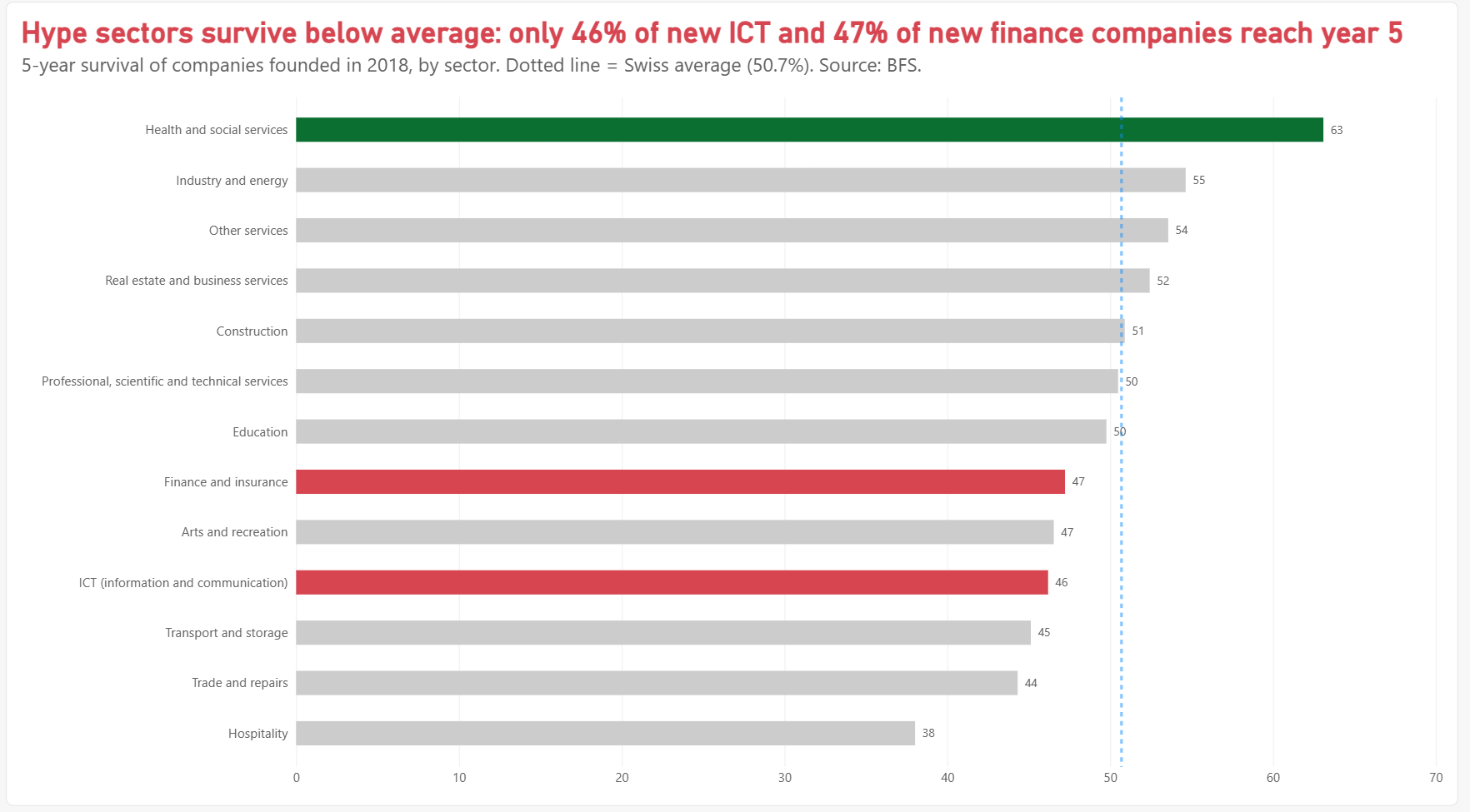
If you want to predict whether a new Swiss company will still exist in five years, ask what it does before you ask where it is. Among companies founded in 2018, the gap between the best-surviving sector and the worst is 25 percentage points: health and social work at 63%, hospitality at 38%.1 The gap between the best and the worst canton is only about five points. What a company does matters roughly five times more than where it does it.
Change the founding year and the number of years in the chart below, and notice how little the order changes. That stability tells me the pattern is structural, not the effect of one difficult year.
The second surprise is where the fashionable sectors land. ICT survives at 46% and finance at 47%, both below the Swiss average of 50.7%. They are not the worst, since trade, transport and hospitality do worse, but the attention these sectors receive clearly does not translate into durability.
A consultant’s lens: competitive pressure
To explain the gap, I used Michael Porter’s Five Forces, a standard strategy tool that asks how much pressure a sector puts on the companies inside it: how easily new competitors can enter, how fierce the rivalry is, whether customers can switch to substitutes, and how much bargaining power customers and suppliers have.
| Sector | 5-year survival | New entrants | Rivalry | Substitutes | Overall pressure |
|---|---|---|---|---|---|
| Hospitality | 38% | High | High | Medium | Very high |
| Trade and retail | 44% | High | High | High (online) | Very high |
| ICT | 46% | High | High | High (AI, offshore) | High |
| Construction | 51% | Medium | High | Low | Medium to high |
| Health | 63% | Low (licences) | Medium | Low | Low |
Survival from BFS; force ratings are my own assessment.
The pattern is striking. Health is the only sector where entry is restricted by qualifications and licences, and it has by far the highest survival. You cannot open a medical practice with a laptop and a website, so weak entrants are filtered out before they start. Demand is stable through every economic cycle, and because much of it is paid through insurance, patients do not bargain like retail customers.
Hospitality is the mirror image. Anyone with enough money can open a café, costs rise faster than prices, and restaurant revenue fell 4.8% in the first quarter of 2026 compared with a year earlier.2 Too often the irreversible bet, a long lease and a full fit-out, comes before the concept is proven. I look at hospitality and retail in detail in part 10.
ICT and finance share hospitality’s low entry barrier, since anyone can open an IT or financial consulting firm, and they add a second weakness: dependence on investor mood. Swiss fintech financing rounds fell from 41 in 2024 to 30 in 2025.3
Hype does not bring durability. The sectors that get the most attention do not produce the most durable companies; barriers to entry and stable demand do.
What this means for a founder
Before choosing a market, ask the questions an investor or a consultant would ask. What stops the next ten competitors from copying you? Will demand still be there in a recession? Who has the bargaining power, you or your customers? A market with a real barrier, whether a licence, a hard-to-earn skill, a trusted relationship or a regulation, is worth more than a fashionable one. The full sector analysis is in sections 3 and 11 of the study.
-
Federal Statistical Office (BFS), Company demography: survival rates. ↩
-
GastroSuisse and KOF, Business survey Q1 2026. ↩
-
startupticker.ch and SECA, Swiss Venture Capital Report 2026. ↩