Swiss startup survival, part 10 of 12
Hospitality and retail: the crisis that has nothing to do with AI
The sectors with the most closures fail on costs, demand and competition. A consultant's diagnosis of where restaurants and shops go wrong, and how they could move instead.
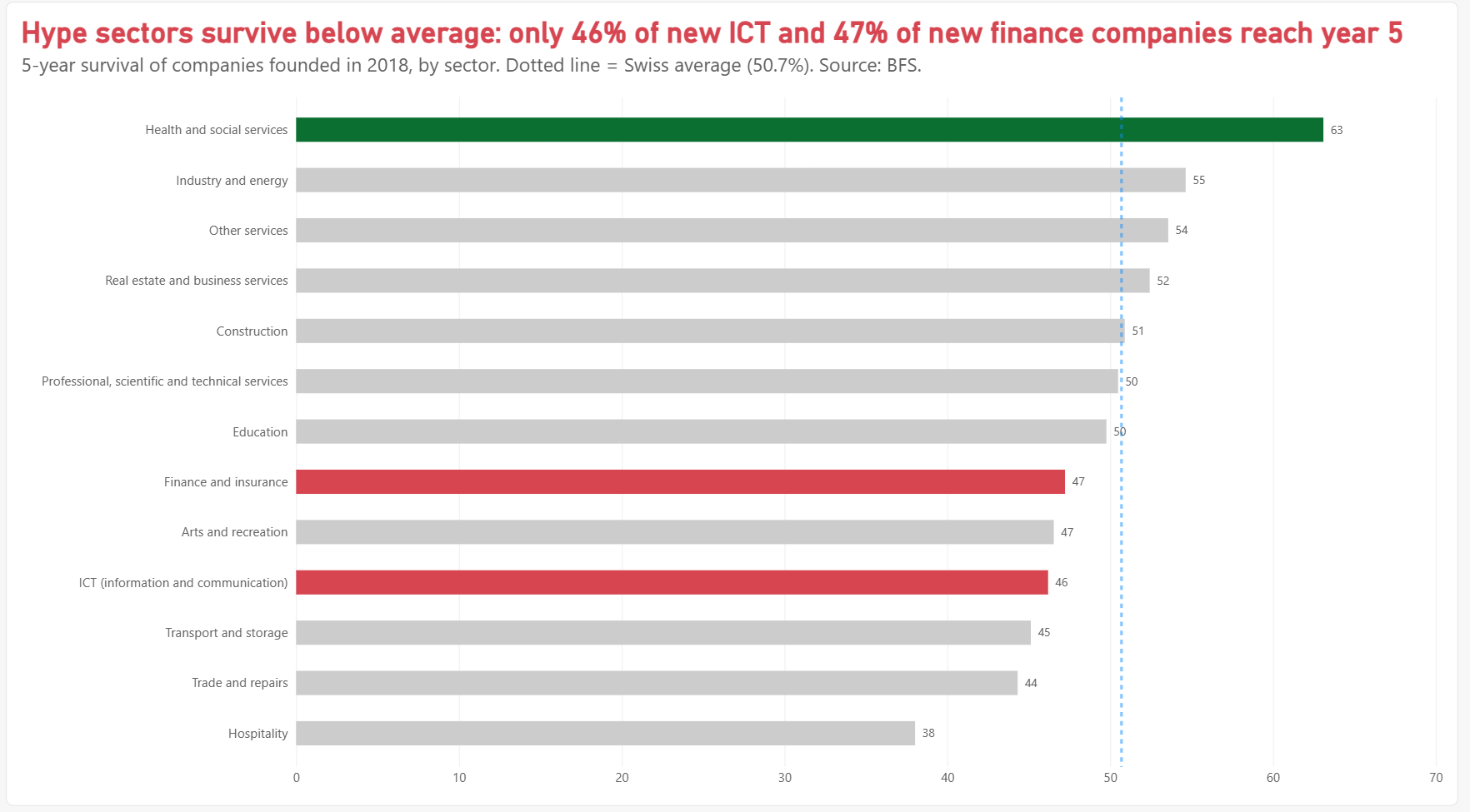
Most of the public conversation about business failure is now about AI. But when I looked at which sectors actually lose the most new companies, the worst performers were restaurants, hotels and shops, where AI barely plays a role. Only 38% of hospitality companies founded in 2018 survived five years, and 44% in trade and retail.1
Hospitality: a cost squeeze, not a lack of guests
Restaurant revenue fell 4.8% and hotel revenue 0.9% in the first quarter of 2026 compared with a year earlier.2 Owners themselves name the causes: staff shortages, rising rents, changing habits such as less alcohol and shorter lunches, and high staff costs. GastroSuisse describes margins that have been eroding for years.3 Chains cope better than independent restaurants because they can share staff across sites and buy in bulk.
When I compared this with the way new restaurants are typically set up, the same mistakes kept appearing. The irreversible bet comes first: a long lease and a full fit-out are signed before anyone knows whether the concept works. Many restaurants end up stuck in the middle, neither the cheapest option nor clearly special, which Michael Porter identified long ago as the weakest strategic position. One person often carries everything, as chef, manager and accountant. And few owners track the numbers that matter, such as cost per guest or the share of revenue spent on staff.
The alternatives are not exotic. Pop-ups, shared kitchens and short leases let a concept prove itself before the big commitment. A focused niche gives guests a reason to come back. Sharing fixed costs with other owners, through staff pools or joint purchasing, protects margins. And simple digital tools for booking, scheduling and stock remove a surprising amount of waste.
Retail: squeezed from two sides
Swiss retail grew only 1.0% in 2025, and non-food fell 2.7%.4 Online sales reached CHF 15.8 billion, and 41% of retailers say they feel the pressure from Temu and Shein.5 Temu alone handles around 50,000 Swiss orders a day, and the Council of States has called for stricter rules for such platforms.6 Shopping across the border remains a habit too.
Shops that fight these platforms on price lose, because the platforms have global scale. The ones that do better compete on what a platform cannot copy: advice, fitting, repair, rental and local speed. Many also use marketplaces as a sales channel rather than treating them only as the enemy, and narrow their range to a niche they can own.
The common mistake across both sectors is making the large, irreversible bet before the concept is proven. Test small first.
Why it matters that this is not about AI
These businesses fail because of costs, demand and competition, the classic forces I described in part 4. That matters for policy. If the public debate focuses on AI, the kind of support that would actually help restaurants and shops, such as lower fixed costs, shared services and cheaper ways to test a concept, gets less attention. The full sector diagnoses are in section 12 of the study.
-
Federal Statistical Office (BFS), Company demography: survival rates. ↩
-
GastroSuisse and KOF, Business survey Q1 2026. ↩
-
NielsenIQ retail study 2025, via Handel Heute. ↩
-
Swiss Post, Swiss e-commerce 2025. ↩
-
Netzwoche, Council of States calls for stricter rules for Temu and Shein. ↩