Swiss startup survival, part 5 of 12
Do not start alone: what company size at founding tells us about survival
Only 49% of one-person starts survive five years, against 68% of companies that start with ten or more employees. The biggest jump comes from adding just one or two people. But the research on solo founders is more nuanced than the headline.
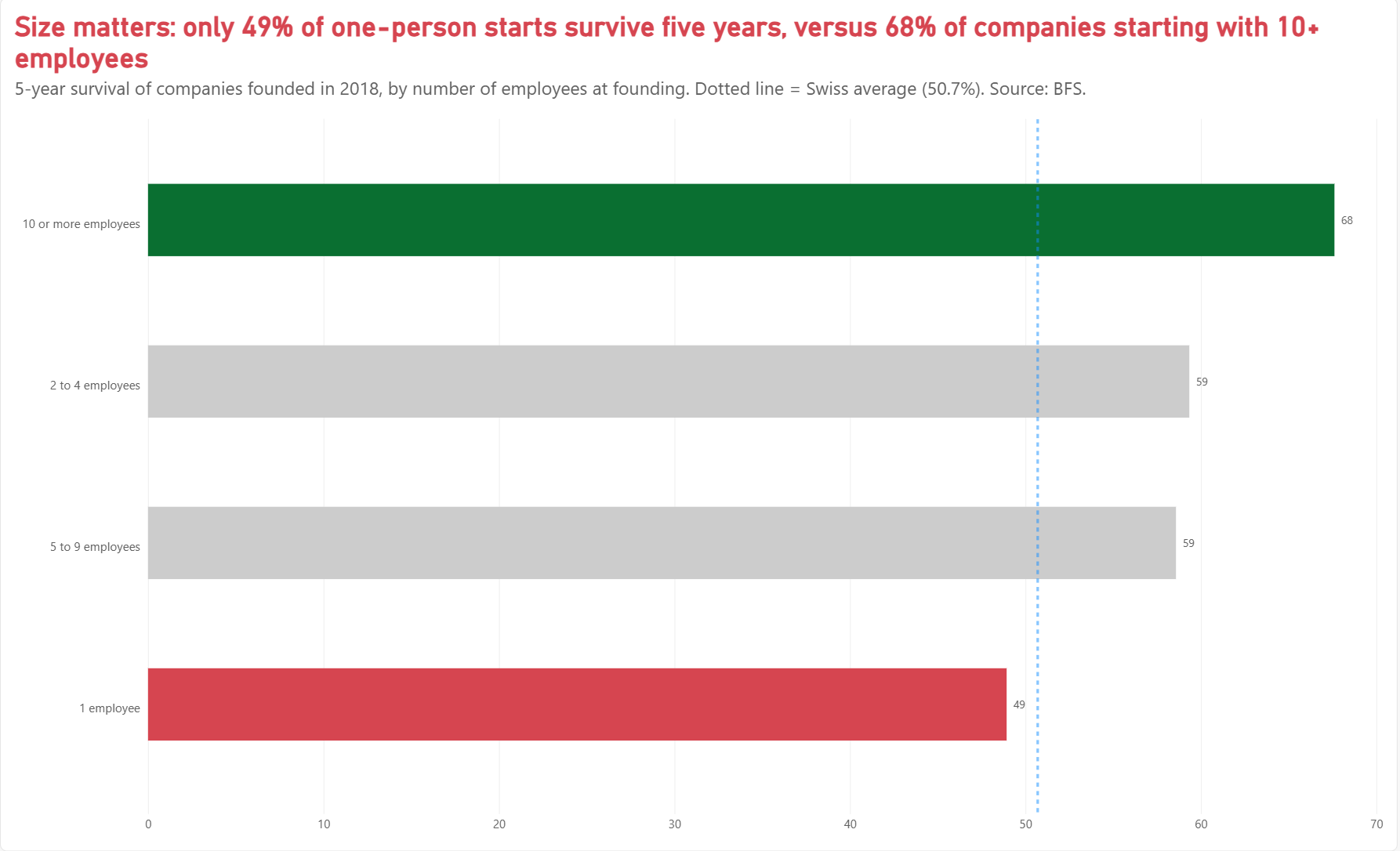
This is the clearest pattern in my whole dataset, and it concerns the most common kind of Swiss company. About 83% of new Swiss companies start with a single employee, a share that has barely changed since 2013.1 It is also the weakest starting position: only 49% of these companies survive five years, while 59% of companies with two to four employees survive, and 68% of those that start with ten or more.
The chart shows how many companies of each size are still alive after one, two, three, four and five years. Watch where the lines separate.
The big jump is from one person to a small team. Moving from one employee to two to four adds about ten points of survival; moving from two to four to five to nine adds almost nothing. The lesson is not “the bigger the better”. It is “do not start alone”.
Capital at the start helps too
Legal form tells a similar story. A GmbH needs at least CHF 20,000 of share capital and an AG CHF 100,000, while a sole proprietorship needs nothing. GmbHs survive five years at 56% and AGs at 55%, compared with 48% for sole proprietorships.1 Foreign companies registered in Switzerland survive worst of all, at 35%, which connects back to Zug in part 2.
The likely reasons are easy to recognise. One person has to sell, deliver, keep the accounts and absorb every setback, so a single illness or one lost client can end the business. A team can combine complementary skills, such as product and sales. And hiring someone or putting in share capital signals a more serious, better-prepared project.
The nuance: what research says about solo founders
As a market researcher, I checked whether the wider evidence agrees, and it is more complicated than “teams win”. A well-known study by Jason Greenberg and Ethan Mollick of crowdfunded companies found that companies started by solo founders survived longer than those started by teams, and earned more than founder pairs.2
These two findings do not actually contradict each other, and the difference is worth understanding. The BFS data measures employees at founding, not the number of founders. A company with one employee is usually one person doing everything. A solo founder in the Greenberg and Mollick study could still build a team around them. There is also a selection effect: founders who are better prepared may both hire earlier and survive longer, so this is correlation, not proof that hiring alone causes survival.
The lesson is less “never found alone” and more “do not try to run the whole company alone”.
Why this matters now
AI tools make it easier than ever to start a company completely alone. In the United States, about 36% of startups founded on Carta in 2025 had a solo founder, up from 31% a year earlier.3 Switzerland shows no shift yet, but if AI pushes more people to start entirely on their own, my data suggests survival would fall.
My advice to a founder follows directly. Find at least one other person early: a co-founder, a first employee or a freelancer with complementary skills. Commit some capital, even when it is not legally required. And decide in advance which tasks you will not do yourself. The full analysis is in section 5 of the study.
-
Federal Statistical Office (BFS), Company demography: survival rates. Survival of companies founded in 2018, by size class and legal form. ↩ ↩2
-
Greenberg, J. and Mollick, E. (2018), Sole Survivors: Solo Ventures Versus Founding Teams, SSRN. ↩
-
Carta, Founder Ownership Report 2026. ↩