Swiss startup survival, part 3 of 12
Lucerne survives without venture capital
Lucerne recorded a single venture capital round in 2025, yet its new companies survive as well as Zurich's, and it improved more than any other canton. What that says about how most Swiss companies are really built.
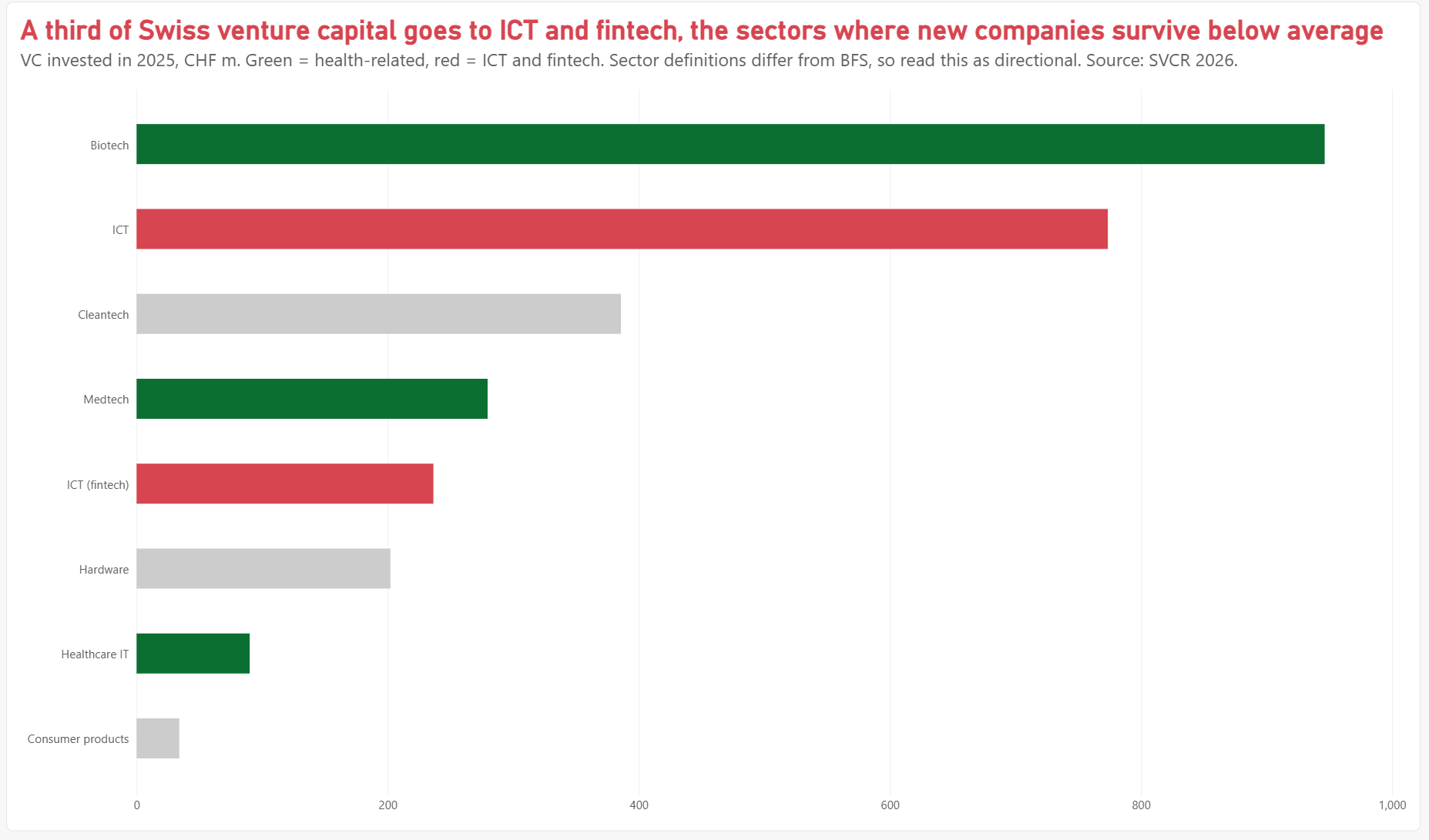
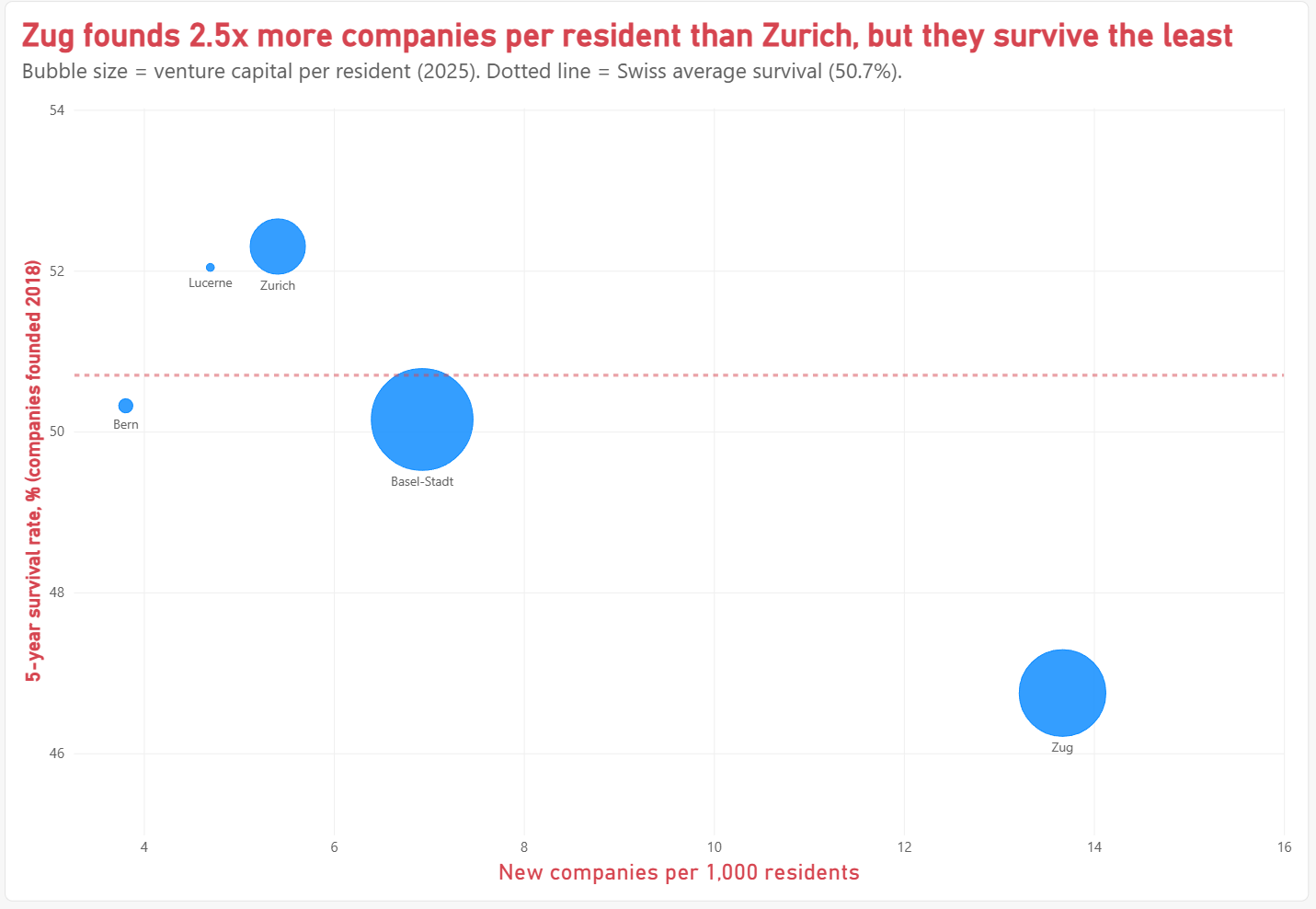
I live in Lucerne, so this finding surprised me personally. In the Swiss Venture Capital Report 2026, Lucerne appears with a single financing round: CHF 125,000 for an early-stage ICT company. Zurich, in the same year, recorded 151 rounds worth CHF 1.19 billion.1 If money drove survival, Lucerne’s new companies should be struggling. They are not.
Companies founded in Lucerne in 2018 survived five years at a rate of 52.0%, practically the same as Zurich’s 52.3%.2 Lucerne also improved more than any other canton I studied, from 48.7% for companies founded in 2013, and in 2021 it had the lowest closure rate of the five, 5.8 closures for every 100 active companies.
The hypothesis I got wrong
Before I looked at any data, I wrote down my expectation: regions with little funding will have lower survival. It seemed obvious. Lucerne is the clearest proof that it was wrong, and in part 6 I explain why money and survival are not linked at all across Swiss cantons.
A rejected hypothesis is a result, not a failure. Writing it down first is what stopped me from quietly forgetting it once the data disagreed.
The short version is a question of scale. Swiss venture capital funds roughly 350 financing rounds a year, while more than 46,000 new companies are founded.1 Most of them, the bakeries, consultancies, tradespeople, clinics and shops, never look for venture capital at all. And venture capital is designed to fund growth, not survival: an investor expects most companies in a portfolio to fail, as long as a few become very large.
So how do Lucerne’s companies survive?
The official data shows the result, not the reason, so what follows are hypotheses that would need interviews and financial data to confirm. Lucerne’s companies are probably financed by their founders’ savings and by bank loans rather than by equity investors, which pushes a business to become profitable early. They probably rely on steady local customers in a stable regional economy. And Lucerne has fewer companies in cycle-driven sectors such as crypto, which rise and fall together. In consulting terms, Lucerne looks like a portfolio of low-risk, low-volatility businesses, which is exactly what you would expect to survive.
The risk of stability
Stability is not the same as growth. A canton with few venture-backed companies also has few scale-ups, and scale-ups create a large share of new high-value jobs. The opportunity for Lucerne is to add a growth layer, through university spin-offs, regional investors and founder support, without losing the stability that already works.
Lucerne maximises durability, Zug maximises volume, and Zurich manages both. These are different strategies, not simply better or worse ones.
The regional comparison in full is in section 13 of the study.
-
startupticker.ch and SECA, Swiss Venture Capital Report 2026, including the list of individual financing rounds. ↩ ↩2
-
Federal Statistical Office (BFS), Company demography: survival rates. ↩