SAP S/4HANA transformation, part 2 of 3
SAP S/4HANA transformations: why people, not software, decide success
A new ERP system only creates value when people use it the new way. Projects with excellent change management meet their objectives seven times more often. Here is what that means for training, for leaders and for the people who have to learn the system while running the business.
In part 1 I showed that most S/4HANA projects miss their plan, and that five of the six biggest barriers are organisational. Two of them are about people directly: staff planned too late (75%) and organisational inertia (37%).12
The strongest lever in the evidence is change management. Prosci’s research with more than 2,600 practitioners found that projects with excellent change management met or exceeded their objectives 88% of the time, against 13% with poor change management.3
Five steps to adoption
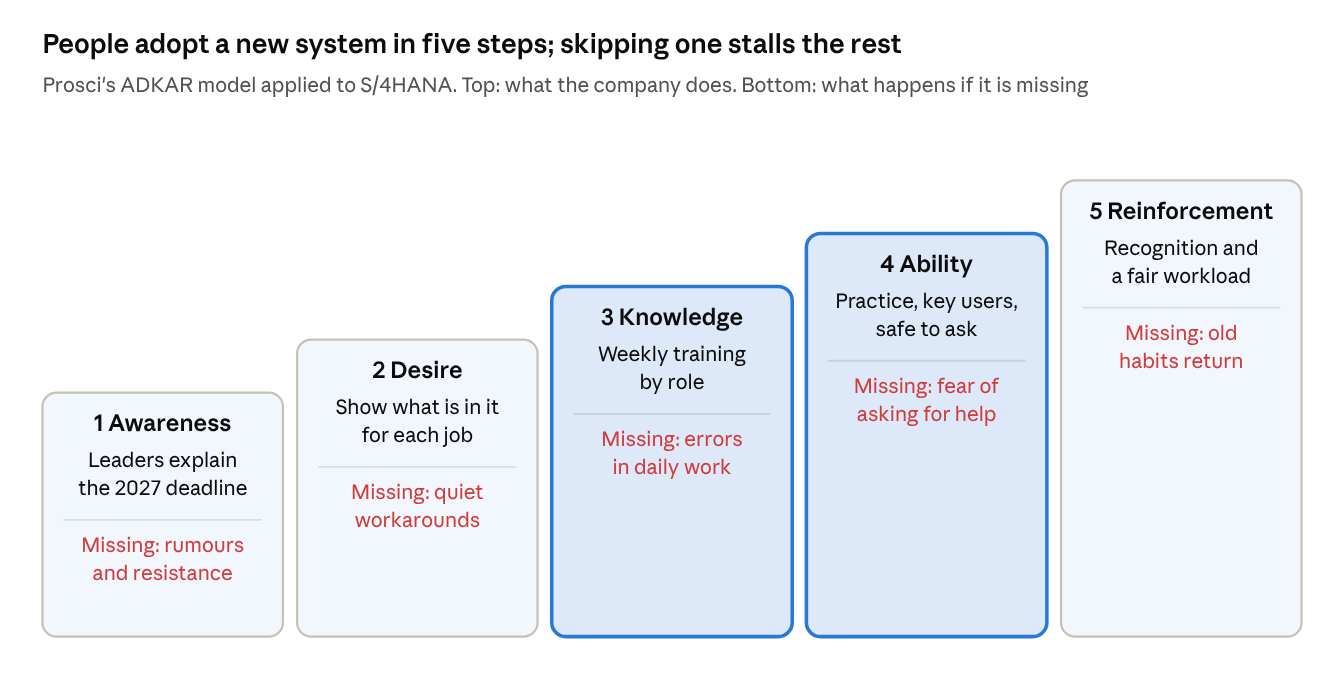
The steps build on each other. Training is wasted on people who do not understand why the change is happening. Practice fails when people are afraid to admit they are stuck. That is why training and a safe culture belong together.
It is not a choice any more
For employees, S/4HANA is not an optional tool. Once the old system is switched off, the new one is the only way to book an order, close the month or ship a pallet. People who are not trained in time do not simply work more slowly. They block the next department.
A rhythm that works:
- Everyone affected: a short “why, and what changes for me” session at the start of each wave.
- End users: hands-on training in their own process, weekly from about eight weeks before go-live.
- Key users, one per team: deeper training, then they coach their colleagues.
- After go-live: floor support and a daily question slot for the first weeks.
Leaders set the climate
Weekly training only works if people feel safe to say “I don’t understand this yet”. A manager who mocks a question teaches the whole team to stay quiet. Silent people build workarounds, workarounds turn into silos, and silos become the bottlenecks that stall the go-live. Harvard professor Amy Edmondson calls the opposite psychological safety: a team where asking for help carries no penalty.
The fastest way to slow down a transformation is to make people ashamed of learning.
What leaders have to do:
- Decide the why and say it in plain words: what gets better for customers, staff and the business.
- Explain the urgency honestly. Support ends in 2027, and every year of delay costs extra fees and scarcer consultants.
- Free people up. Key users cannot learn a new system and run the old business at full load.
- Support without judgement, in every training session and every meeting.
- Protect wellbeing. Go-live months mean double work. Plan realistic workloads, thank people visibly and set a clear end date for the extra load.
What comes next
People and leadership are half of the answer. In part 3 I show how consultants organise the rest: daily updates between departments, a smaller first wave and SAP’s own method. The full report is here.
-
Horváth, SAP S/4HANA transformations rarely go as planned, April 2025. ↩
-
ASUG survey via The Register, Two-fifths of SAP Americas users yet to ditch legacy ERP, November 2025. ↩
-
Prosci, The correlation between change management and project success. ↩