MSc qualitative research Completed
How HSLU dining shapes sustainable food choices
Do university cafeterias change how new international students eat? Five in-depth interviews showed that values are strong, but price, convenience and language decide what ends up on the tray.
How do incoming international students perceive and experience the role of HSLU dining services in shaping their sustainable food practices?
Key findings
- Sustainability is a personal value students bring with them. The cafeteria reinforced existing beliefs rather than creating new ones.
- Price, convenience and mental effort decided actual choices: a clear attitude-behaviour gap.
- The cafeteria itself enabled sustainable choices through vegetarian options, variety and reusable materials.
- Communication was the main barrier: menus mostly in German made students guess or translate with their phones.
- Social influence mattered only in specific situations, such as eating with a project group.
How we did it
Why this question matters
Food systems are responsible for about a third of global greenhouse gas emissions (Crippa et al., 2021), and what people eat is one of the few levers individuals control every day. Universities feed thousands of people daily, so their cafeterias shape habits at scale. Research also shows that the food environment itself changes choices: when Cambridge cafeterias offered more vegetarian options, the share of vegetarian meals sold rose (Garnett et al., 2019).
International students are a particularly interesting group. They arrive in a new food culture, with new prices, new products and often a new language, at exactly the moment their habits are open to change.
The theory behind our interview guide
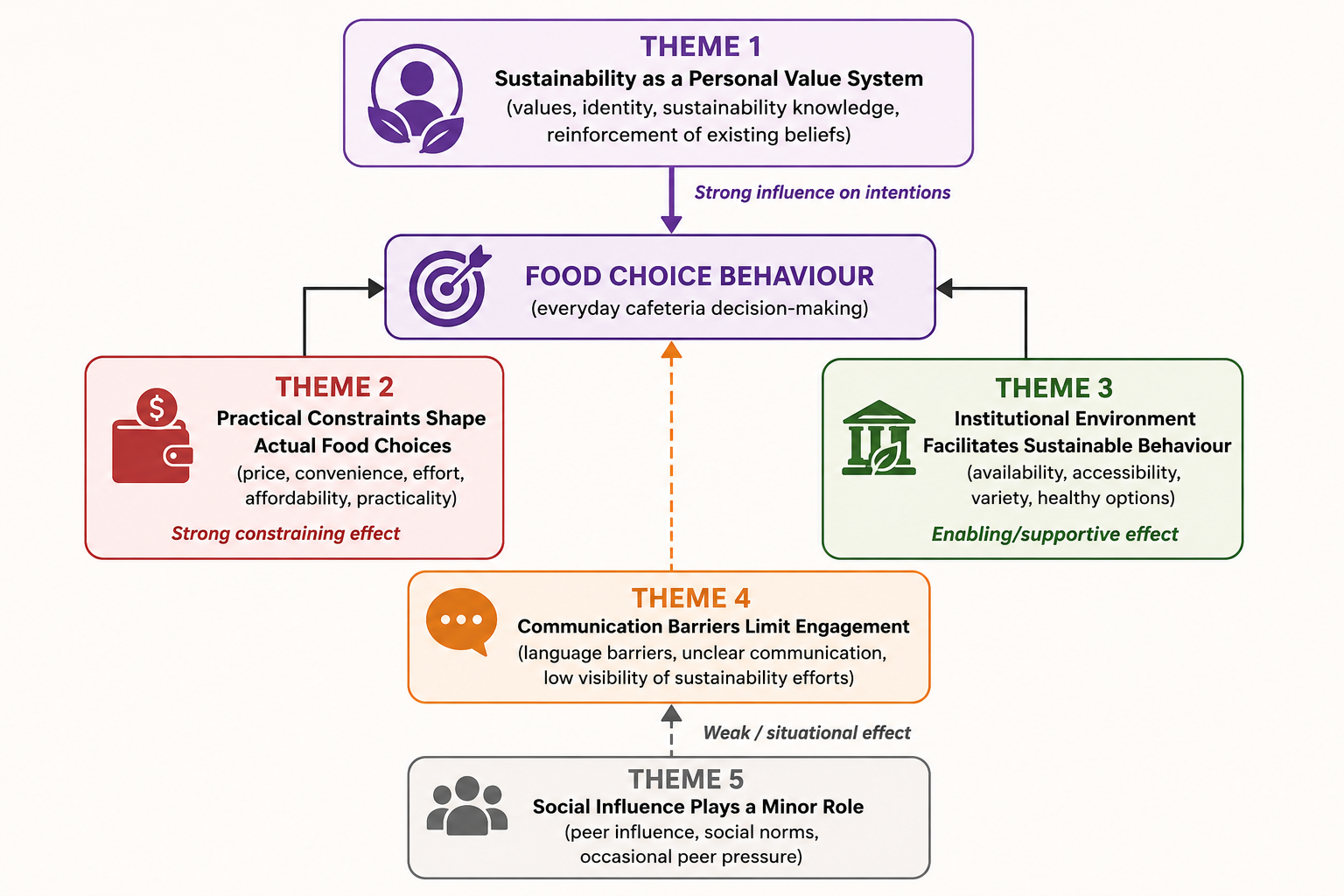
We built the study on the Theory of Planned Behaviour (Ajzen, 1991). It explains behaviour through three factors: attitude, the expectations of people around you, and how much control you feel you have. The diagram shows what our interviews found for each:
How we did it
We chose problem-centred interviews over focus groups. In a group, students tend to say what sounds socially acceptable about sustainability. One-to-one, they describe what they actually do.
Each of the five team members conducted one 45 to 60 minute interview with a newly arrived international student, recorded with consent and transcribed. We coded the transcripts with descriptive codes (what is being described) and in vivo codes (the student’s own words), added codes that emerged from the data, and grouped them into five themes on a thematic map.
The five themes, in the students’ own words
1. Sustainability as a personal value. Students arrived with their values. One described vegetarianism as “not just a lifestyle, but also a conscious choice”. The cafeteria reinforced these values rather than creating them.
2. Practical constraints decide. Values lose to the wallet: “Sustainable food is more expensive… the money factor is important to me as a student.” One student preferred the buffet for its quality but chose the set menu “because of the price difference”.
3. The cafeteria enables. Students praised the modern, clean space, the vegetarian and vegan options, and the reusable takeaway boxes. Sustainable choices were easy to find, but availability alone did not decide behaviour.
4. Communication blocks engagement. “Everything is in German… I have to take a picture and translate.” Another student had “no idea what their sustainable practices are”. The practices existed; students simply could not see or read them.
5. Social influence is situational. Most students decided for themselves, but group lunches and seeing what others picked shaped choices on specific days.
Values were strong, but perceived control decided behaviour. This is the attitude-behaviour gap described by Vermeir and Verbeke (2006): people intend to buy sustainably, but price, convenience and information decide what they actually do.
What a university could do with this
- Show menus in more languages on the existing screens, as one student suggested.
- Introduce the cafeteria in the welcome programme for international students, including its sustainability practices.
- Make sustainable options the affordable default, because values alone do not beat price and convenience.
Limitations we named
Five interviews cannot represent all international students; answers were self-reported; and students were interviewed early after their move to Switzerland, so their habits may still change. A larger study could combine interviews with actual purchase data from the cafeteria.
What I learned
How to design an interview guide that gets real behaviour rather than polite opinions, how to code qualitative data step by step, and how to turn quotes into evidence a decision-maker can use. The same skills now drive my healthcare and SME consulting projects.
Visuals
Sources
- Crippa et al. (2021): Food systems are responsible for a third of global anthropogenic GHG emissions, Nature Food
- Garnett et al. (2019): Impact of increasing vegetarian availability on meal selection and sales in cafeterias, PNAS
- Vermeir and Verbeke (2006): Sustainable food consumption, exploring the attitude-behavioural intention gap
- Steg and Vlek (2009): Encouraging pro-environmental behaviour, Journal of Environmental Psychology
- Brown, Edwards and Hartwell (2010): Food and international postgraduate students, Appetite
- Poore and Nemecek (2018): Reducing food’s environmental impacts, Science